
Standens Barn stabbing: ‘Put emotion aside to give him the benefit of the doubt,’ defence concludes

The defence asked the jury to “put emotion aside and the sadness that somebody has died” to give the defendant “the benefit of the doubt”, after he was “deceived” into attending what he thought was a peace meeting.
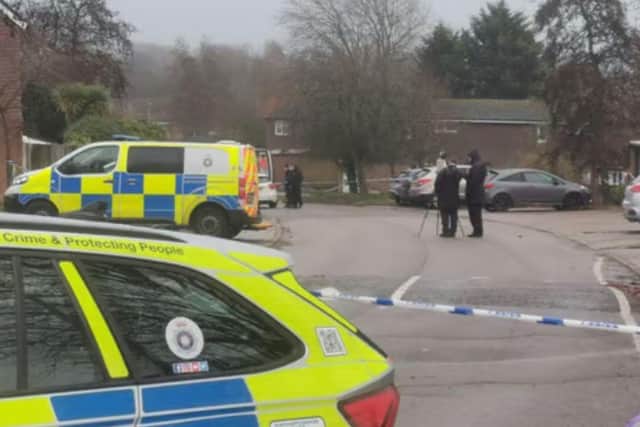
The trial continues for the man accused of murdering 23-year-old Clinton Obeng Oppong Antwi, after a jury was sworn in on May 27.
Junior Emmanuel Uwadia, of Northfield Way, Northampton, denies murdering Clinton – who died in Flaxwell Court, Standens Barn on Thursday, December 11 last year. Uwadia also entered a plea of not guilty to having an article with a blade or point.
May 28 marked the first day of evidence in the trial before Her Honour Judge Rebecca Crane, which is estimated to last for around three weeks.

On Wednesday (June 11), following the Judge’s directions on law and the prosecution’s closing speech, the defence’s final remarks were led by Benjamin Aina KC.
‘He hasn’t been the aggressor, he was attacked’
Mr Aina KC began by reminding the jury of the need to put aside their emotions when assessing the evidence, and took them back to the day of the initial disagreement.
The defence said that the initial argument was “not just about food”, which Mr Aina KC said the prosecution painted during their initial opening of the case.
Mr Aina KC said it may have started out over a “trivial matter” but during the initial disagreement, Clinton pushed Uwadia in the chest with clenched fists – which was supported by the evidence of the second mutual friend.
“Clinton assaulted Junior,” said Mr Aina KC. “That’s not a trivial thing. That’s not an argument, that’s a criminal offence.”
Having addressed that Clinton was “persistent” that he did not want to be friends with Uwadia following the disagreement, the defence brought up that an “anger issue” was in Clinton’s character and he was “not willing to cooperate”.
“The purpose of going back to Flaxwell Court on December 10 was so there could be some sort of reconciliation,” said Mr Aina KC, who shared the defence’s belief that Uwadia was calm and Clinton was not.
The defence maintains that Uwadia being in possession of a knife in Flaxwell Court on the evening before the fatal stabbing was “all bravado”, as it was “just a shouting match” and Clinton allegedly did not see the knife. The court heard the aim was for the pair to “show each other they can stand their ground”.
Mr Aina KC referenced the evidence of the second mutual friend, who recalled Clinton trying to drive his car at Uwadia repeatedly. This witness described the incident on December 10 as “child’s play” and the defence says this witness believed “the person trying to escalate matters was Clinton”.
The defence told the jury that they believe the first mutual friend who gave evidence was “not a witness of truth”. In his initial statement for the police, that witness said Uwadia caused damage to Clinton’s car by kicking it – and before the jury, he then said Uwadia had used a knife.
Mr Aina KC said the prosecution “cherry picked” messages to include in their closing speech, to paint Uwadia as an “angry man”.
When the messages were exchanged between the defendant and the first mutual friend, Mr Aina KC maintained that Uwadia saying “do you really want Clinton to die” with emojis was “all bravado”.
It was this mutual friend who persisted in getting Uwadia to return. The defence says that when it was made clear that a fight was going to happen, the defendant made his intention to hold off clear.
When referencing messages about getting “guns involved” from Uwadia, Mr Aina KC asked the jury to consider if this was “serious or bravado” – and mentioned Uwadia’s education and no previous run-ins with the police.
The defence maintains that Uwadia made it clear that he wanted to let the dust settle and was led to believe that Clinton wanted to make peace by what he was being told by the first mutual friend. Mr Aina KC described this as “the beginning of the deception of Junior”.
“The only reason why Junior was at that meeting was because he trusted [the first mutual friend] that he was going to a peace meeting,” said Mr Aina KC.
The defence told the jury their belief that the second mutual friend would not have got in the car to go to the location of the fatal stabbing had he known “Junior was being tricked”.
Mr Aina KC said that when the cars met in Flaxwell Court on December 11, Clinton did what “he had intended to do” and started a fight by punching Uwadia in the back.
The defendant did not have anything in his hands or make an attempt to take the knife out of his bag at that moment, the court heard. “It’s simple,” said Mr Aina KC. “The guys attacked me from behind, I’m defending myself.”
The defence maintains that Uwadia was attacked with the metal canister weapon, restrained and defended himself after being “tricked and fooled” into thinking it was a peace meeting.
The members of the jury were asked what they would do if someone had a knife in one hand and a metal canister in the other, as Clinton was the one who picked up the knife when it fell from Uwadia’s bag “by accident”.
Mr Aina KC described Uwadia’s car as his “place of safety and sanctity” and asked the jury to consider if he was entitled to go to his car, stop Clinton from damaging his car, and to try to get the knife away from his car.
“He didn’t have the luxury of thinking time,” said Mr Aina KC, who mentioned that the struggle lasted around eight seconds. “It was in the heat of the moment.”
Talking about the jury’s consideration of self defence, Mr Aina KC said: “He hasn’t been the aggressor, he was attacked.”
Mr Aina KC reiterated that self defence may include reacting on the spur of the moment. “He cannot be expected to work out exactly how much force he needs to use to defend himself,” Mr Aina KC continued.
The defence then moved on to the suggestion that the first mutual friend, who was called to the witness box to give evidence, “lied, lied and lied”. Mr Aina KC outlined 15 areas in which this witness was allegedly not telling the truth.
This included the evidence about the conversation that this witness had with the defendant following the incident, in which Uwadia allegedly said “I f***ing told you this would happen” – which has been mentioned throughout the prosecution’s case.
Mr Aina KC said that when Uwadia left the scene “in a panic”, he still believed Clinton was alive. There was a note on the defendant’s phone from 6.40pm on December 11, which stated “never meet with Clinton ever again” even if a mutual friend tries to convince him.
Mr Aina KC then reminded the jury that Uwadia has been entitled to remain silent, including when asked to take the stand and give evidence and in his initial police interviews.
The defence maintains that the prosecution “gave the impression it was all Junior’s fault” and the jury needs to question if they can trust the way the case has been presented by the prosecution.
“Junior is a man of good character,” concluded Mr Aina KC. “Described by [friends] as a good friend and a really nice guy. A man willing to help without complaint.
“A man who had been deceived to go to that meeting on December 11. A man who had to make a judgement call within seconds after he got his knife.
“There was no reason to have his knife in the bag, of course not, but he didn’t take this knife out to use. Put emotion aside and the sadness that somebody has died to give him the benefit of the doubt.”
The trial continues.
Read the previous Chronicle & Echo stories from this ongoing murder trial here…