
Standens Barn stabbing: Defence alludes to ‘metal canister’ being used as ‘weapon’ by victim

The jury was taken through CCTV evidence frame by frame, captured by a camera on a house opposite the car parking area where the fatal incident took place in Standens Barn.
The prosecution opened the trial of a man accused of murdering 23-year-old Clinton Obeng Oppong Antwi, after a jury was sworn in on May 27.
Junior Emmanuel Uwadia, of Northfield Way, Northampton, denies murdering Clinton – who died in Flaxwell Court, Standens Barn on Thursday, December 11 last year.
Uwadia has also entered a plea of not guilty to having an article with a blade or point.
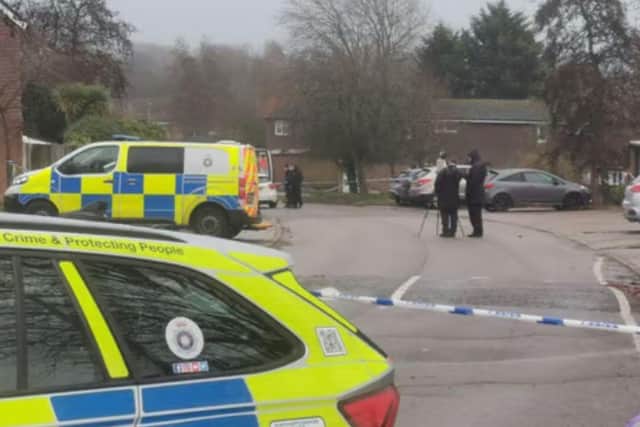

Yesterday (May 28) marked the first day of evidence in the trial before Her Honour Judge Rebecca Crane, which is estimated to last for around three weeks.
This included a frame by frame run through from a camera fixed to the side of a house that was opposite the car park where the fatal incident took place on December 11, 2024.
Mr Dale was then cross-examined by Benjamin Aina KC, defending 25-year-old Junior Uwadia, and began at the footage from the evening before the incident (December 10).
Mr Aina KC questioned whether the item that the victim dropped and picked up as he returned to his vehicle from Flaxwell Court may not have been a mobile phone.
The defence described the way the item was “reflecting” and referred to the potential of it being a “metal canister”.
Witness Mr Dale agreed that Mr Aina KC’s point was fair, and that the possibility of it being a metal canister cannot be excluded. The witness was keen to agree with Mr Aina, the court heard.
The defence explained that the metal canister had been brought up before the jury as it has been “suggested” that on December 10 and 11, Clinton “had a weapon”.
Mr Aina KC moved onto the house CCTV footage from December 11 and mentioned a “metal clanging noise” that can be heard multiple times.
The defence asked if that was a defect in the CCTV or if that noise could be attributed to a metal canister being used in the action, the court heard.
Mr Dale explained this is one of the reasons why he went to visit the house where the CCTV was retrieved, and said he could not find or see anything that would make the noise that can be heard.
Later on during the cross examination, Mr Aina KC asked if Mr Dale could see a reflective object in Clinton’s hand and the witness replied “No, not at all”.
“The jury are going to hear about a metal canister,” said Mr Aina KC, who questioned if no one asked him about it throughout the investigation.
Mr Dale explained that they are told “not to speculate” or exhibit “unconscious bias” about what an object or noise on CCTV could be based on other information in the case.
Before moving on, Mr Aina KC asked if the noise sounded “metallic” and Mr Dale confirmed that the noise was “very similar” to what was heard earlier in the footage.
Talking about when Clinton stepped back and picked something off the road, Mr Aina asked if this was a “metal canister” or something else. Mr Dale explained that the CCTV footage is too bright to even see a hand clearly, or what might be in it, the court heard.
Later in the cross examination, Mr Aina KC “suggests” that the jury is going to hear more than one person (referring to witnesses to come in the trial) say that Clinton punched Uwadia in the back during the incident.
At this point, he was referring to when the victim, defendant and first mutual friend had all moved across the road of the car park towards Uwadia’s vehicle.
Mr Dale shared his belief that the jump in the footage, which was worked out to be a total of 16 frames and around a second long, does not omit any contact between the victim and the defendant, the court heard.
The defence refers to the victim “striking blows with a weapon” and Mr Dale said he cannot see that in the CCTV.
Mr Aina KC proposed to the court that Clinton was hitting the defendant with a canister in his hand, while Uwadia was being restrained by the mutual friend. “Can you say that proposition is wrong from the CCTV?,” questioned Mr Aina KC.
“I can’t say it’s right,” said Mr Dale, who explained that the footage is too far and not clear enough for that scenario to be seen, including who has got what in their hands.
Mr Dale agreed that he could see three people come together and that the victim was not restrained and had free movement.
During the reexamination by Mr Vout KC, prosecuting, Mr Dale confirmed his view to the jury that there remains distance between the victim and defendant before and after the 16 missing frames from the footage.
The witness also told the court that the metallic clanging sound that was referred to throughout was not attributed to anything in the visuals by Northamptonshire Police.
The trial continues.