
Bold Reimagining and Stark Atmosphere: A Thought-Provoking Adaptation, If Not Quite a Full-Blown Tragedy
The beauty of theatre is its capacity to transport you to an otherworldly reality within the four walls of an auditorium. At its best, the audience really buys into that reality.
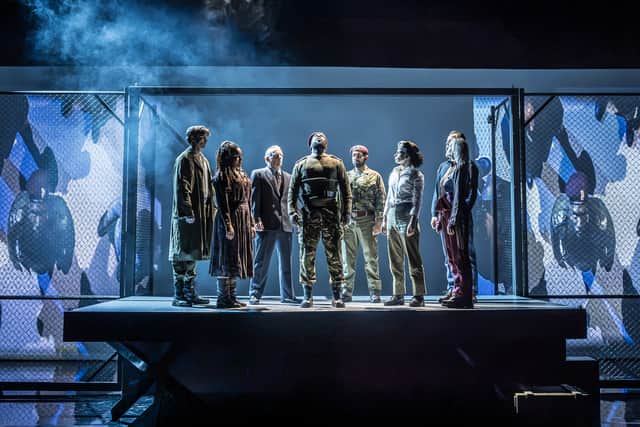

Stepping into director Anthony Almeida’s production of Othello on the Royal Stage, that sense of transport—first to London in the 1980s and then to the Falklands—is arresting, particularly when Shakespeare’s well-known tale is spoken in the original verse.
If you are familiar with Shakespeare's Othello, it forces you to rethink what you thought you knew.
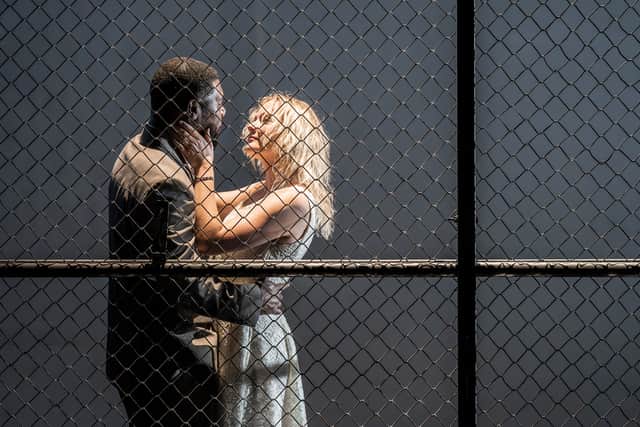
Driven by bitter resentment over a passed-over promotion, the villainous Iago orchestrates a web of deceit to convince the general Othello that his new bride, Desdemona, is unfaithful.
Almeida’s vision is framed by a monochrome, caged set that deliberately feels claustrophobic, forcing the action directly onto the actors.
An intense, repetitive beat gradually winds up the tension. Many of the cast are dressed in modern military attire, while Desdemona’s father sports a sharp grey suit. Desdemona herself begins the play in a more masculine style—wearing trousers and a button-down shirt.
Some of the production's highlights stem directly from these artistic choices, particularly in the first half. Desdemona and Othello's wedding is celebrated through dance, and the squaddies’ scene where Cassio (Will Stanton) succumbs to drink—fuelled by a lively rendition of Come On Eileen—gives a ‘fun’, grounded reason for him to get drunk. The staging offers several striking visual touches, including the impressive sight of Othello slow descent onto the stage.
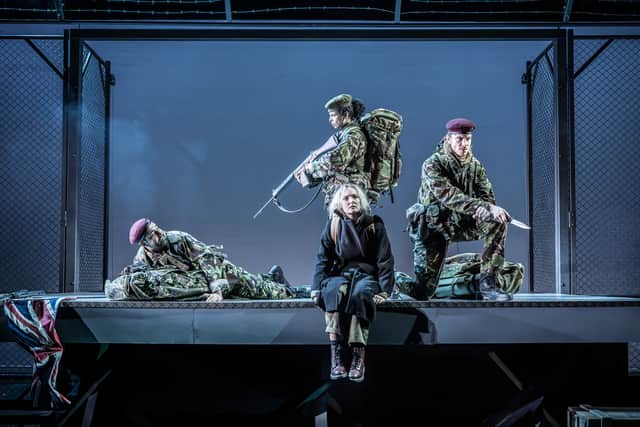
Themes of racism, domestic violence, and sexism underpin the play—thrown into fresh relief by updating the setting to the 1980s and using contemporary casting choices.
On the one hand, this highlights how far society has come, while on the other, it shows how some things haven’t. By featuring a racially diverse cast, the production adds an extra layer to the play's exploration of prejudice. Having Iago played by Maanuv Thiara (an actor of South Asian heritage) makes his racist taunts toward Othello (Dwane Walcott) feel particularly unsettling.
Maanuv Thiara presents a comrade-like version of Iago—a soldierly figure who is, in essence, a weaselly villain. While it felt slightly strange seeing Iago played in standard military gear, he succeeds in creating an unpleasant character.
Phoebe Smyth delivers a rich debut with her Desdemona, who, despite her initially tomboyish garb, is a vulnerable foil to Othello. Her white skin seems to glow whiter in the dark, and her eyes, captured on the big screen at the back of the set, show her confusion as she becomes a victim to Othello’s growing paranoia. Dwane Walcott gives a commanding performance as Othello, bringing physical authority to the role, while Chris Garner is charismatic as Brabantio, Desdemona’s father.
This adaptation introduces an interesting concept around the idea of image, surveillance, and who is watching. A television in the first scene and a large screen depict this idea. Roderigo (Matthieu Sys) is reimagined as a journalist who projects live images onto the screen, emphasizing the public eye. Crucially, however, the most intimate moments of domestic violence go unrecorded inside four walls —perhaps suggesting that real abuse often occurs precisely when the cameras aren’t rolling. The beauty of the cage design in the second half of the play, allows for personal interpretation.
Setting the tragedy within a 1980s military context personally raised a few questions of plausibility. Othello’s sudden flip from devoted newlywed to enraged killer occurs almost instantaneously, seemingly sparked by a single manipulative conversation, and a handkerchief.
In the programme notes, Almeida explains that his vision centers on the "tiny acts of adaptation, restraint, and performance we all make in order to belong." Yet this theme doesn't fully translate into Othello’s descent into rage. Rather than exploring the heavy psychological pressure on an outsider who feels he cannot afford a single misstep, we simply witness a man turning into a murderer overnight.
Similarly, Desdemona’s sudden shift from an assertive, tomboyish figure into a submissive victim feels unexplained. These sudden shifts in character development perhaps prevent the tragedy from building its full emotional weight.
Visually, however, the narrative still offers evocative moments. As the cage doors close and with Desdemona dressed in a fluid white dress, a haunting atmosphere of an asylum is evoked. It serves as a striking visual metaphor for the madness within: she willingly steps inside the cage, only to realize too late that there is no escape.
Anthony Almeida’s 1980s reimagining is a visually striking experiment and provides an engaging, thought-provoking night at the Royal Stage—one that leaves you interpreting its modern themes long after the lights go down.
Produced by Northern Stage, along with HOME Manchester, Citizens Theatre and Royal & Derngate Northampton, the production of Othello runs at The Royal & Derngate until Saturday 17th October.