
Plans for 100 homes next to Northampton woodland given go-ahead after appeal – despite more than 700 objections

Plans for 100 homes next to Harlestone Firs have been given the go-ahead by a government planning inspector – despite more than 700 objections from local residents.
The decision overturns West Northamptonshire Council's refusal of the controversial scheme and means developer Barwood Development Securities can now take the project forward.
The inspector's decision was issued on Monday, September 7, following a hearing in July.
The plans are for up to 100 homes on land between Harlestone Road and York Way, alongside the woodland.
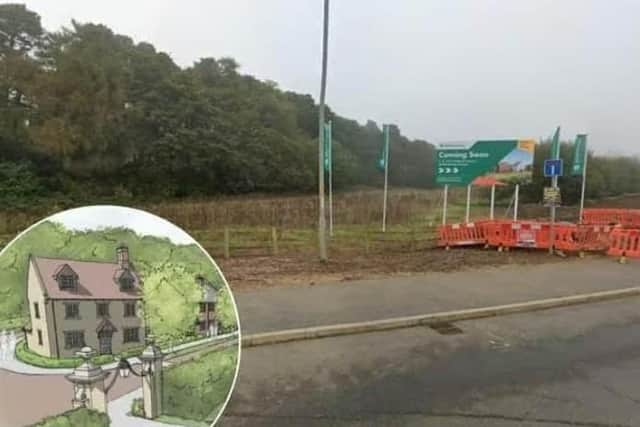

The scheme includes 40 per cent affordable housing, a new access from York Way, pedestrian links into Harlestone Firs, a visitor car park, public open space and a play area.
But the decision is likely to anger opponents who fought the plans on the grounds that the development would eat into open land next to the woodland and change the character of the area.
The council had originally refused the scheme after a planning committee meeting in October 2025.
At that meeting, 731 letters of objection had been submitted.
Residents warned that building on the site would destroy the open buffer around Harlestone Firs and damage the tranquillity of the woodland.
One resident told councillors at the time: “Once that buffer is gone, the character of Harlestone Firs will change and we can’t get it back.”
Harlestone Parish Council previously said: “Harlestone residents are appalled by the proposal. We feel very strongly that eroding the countryside like this is bad for the village and bad for the town – it’s a much loved recreation spot and putting housing right next to it will be massively detrimental to Harlestone Firs.”
Despite planning officers recommending approval, councillors narrowly rejected the application.
The developer subsequently appealed and asked for a public inquiry.
Now the government-appointed inspector has sided with the developer.
The inspector acknowledged that the proposal conflicts with parts of the existing development plan.
The site is outside the confines of a village and outside the nearby sustainable urban extensions, meaning the scheme conflicts with policies governing where new housing should be built.
However, the inspector found that West Northamptonshire cannot demonstrate a five-year supply of housing land.
The council's latest figure was 4.3 years, while the developer argued the figure was lower.
The inspector said the exact figure did not change the outcome because both sides agreed there was a shortfall.
That housing shortage carried ‘significant weight’ in favour of the development.
The inspector also said the 100 homes would make a strong contribution to housing supply, with 40 affordable homes included.
The inspector said: “It is also imperative in this case to note the wider benefits of the appeal proposal, beyond the provision of increasing housing supply. Critically, this development would be capable of being built out quickly, owing to its relatively low number of homes. This would provide this much needed housing and these affordable units in a short time frame.”
One of the biggest concerns from residents was the effect on the woodland.
The inspector said: “I find no evidence to support the assertion that the woodland comprising Harlestone Firs would be lost as a consequence of the development. Rather, the information before me demonstrates that the woodland would be retained and protected throughout the construction period and post completion through an appropriate buffer. Whilst there would be some limited loss of lower-value hedgerow vegetation to accommodate access arrangements, this does not substantiate the claim that the proposal would result in the removal of Harlestone Firs itself.”
Another concern was lack of infrastructure. The developer said: “It has been suggested that local infrastructure, including schools, GP surgeries and hospitals, is already operating beyond capacity. The planning system cannot reasonably prevent development solely on the basis that such services are experiencing capacity constraints.”
The inspector also rejected arguments that simply being inside the Green Wedge meant the development could not be built.
Instead, the decision said the council's policy required the specific effect of the scheme on the Green Wedge to be considered.
The inspector concluded the woodland, its size and the surrounding landscape would maintain separation between the new development and the rural villages beyond Harlestone Firs.
One of the benefits highlighted in the decision is improved public access. Three permissive paths are planned into Harlestone Firs, together with a pedestrian crossing over York Way.
The scheme will also provide more than the minimum amount of on-site open space required, including a play area, amenity space and accessible natural greenspace.