
Meet Jarno Zaffelli - the genius F1 track designer behind Kart Silverstone & the new-for-2026 Madring

It was the morning after the night before. Less than 24 hours earlier, I had the most fun I have ever had in a go-kart, around the new world-class facility at Kart Silverstone.
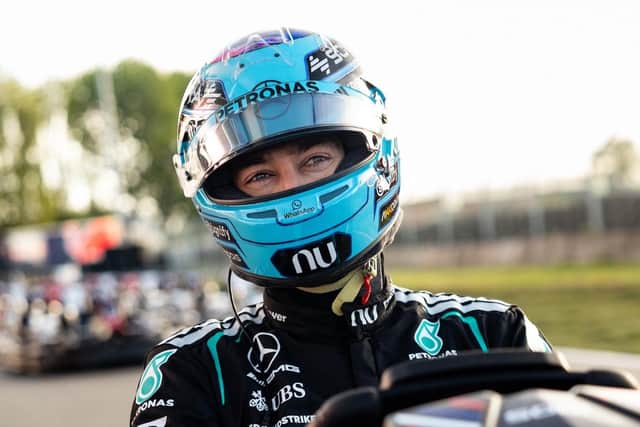
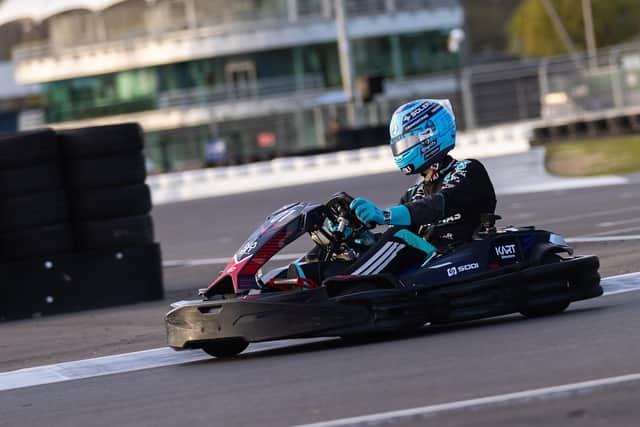
Opened with a hot lap by none other than George Russell, I was one of only 18 to give the track its first go right after the championship-contending Mercedes F1 driver.
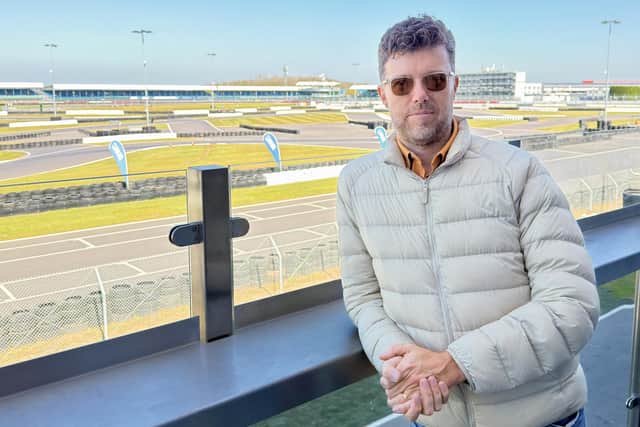

As I sat down in the briefing room waiting for my fellow karters to suit up, I was nervous. The track looked so quick and some of those turns… they looked menacing.
Into the room wanders another man ready to take on the track, who began working out his helmet size. It wasn’t until 10 minutes of small talk later that it became apparent he wasn’t just any regular bloke. Rather, he was the designer of the track itself.
I couldn’t get over myself. I’d just been asking him silly questions like, ‘Have you karted before?’, and, ‘How are you thinking about taking those hairpins?’. He knew exactly how. He created them himself.
Not only that, but I soon found out this man - Jarno Zaffelli - is the founder and CEO of F1 circuit designing firm Dromo, responsible for the redesign of Zandvoort in 2021, the curation of the new-for-2026 Madring, as well as the resurfacing of Silverstone Circuit in 2019.
Much to my delight, Jarno was more than happy to be interviewed the next morning. And that’s how we got here. To talk about the inner workings of this amazing facility at Silverstone.
How did this new karting track all come about, then?
Well, Jarno, from Reggio Emilia in northern Italy, was tasked with building an elite circuit capable of being a talent factory for up-and-coming British karters – all while being utilised year-round for the leisure of the general public.
That, as it turns out, wasn’t a straightforward process.
As much as Silverstone as a client was a dream to work with thanks to their trust in Jarno and his Dromo team to get on with the job in hand, there were many hurdles to overcome, not least the FIA’s minefield of requirements.
“You need to remember that during Formula 1, this is a multi-use platform that they’re using for concerts,” Jarno says of the site the karting track is based on.
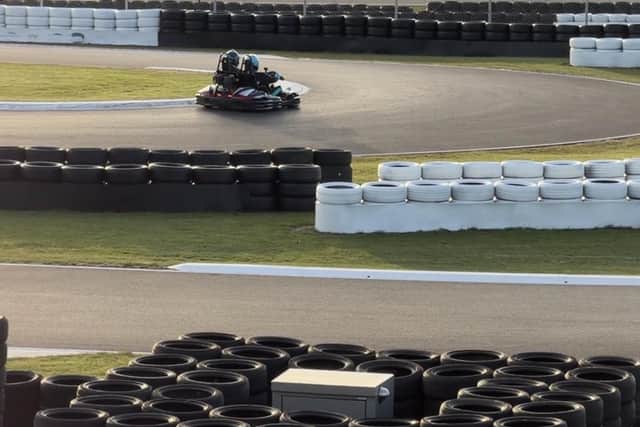
“The first thing to do was to build something that was working year-round, and as a multi-use platform when there is F1.”
When asked whether it was a logistical nightmare, Jarno admits: “Yeah, it was.”
He then shows me a photo of what the now karting track area looks like during the Silverstone Grand Prix weekend.
“Look, half of the track here at corners one, two, three and four is covered by all the concert area.
“So, we designed it in a way that we had the space for the concert, the space for the public, all the right acoustics, all the people going there, and the fan zone.
“It was not easy. Everything was done to be possible to be removed. For example, the lights. And so on.”
That was only the first part of the brief. Then comes the next – arguably an even bigger challenge, even for a design whizz.
“Second brief, we need to have multiple layouts. Why? Because we want to run concurrently,” Jarno adds.
Silverstone required a venue that could run several races at the same time. One for juniors and one for more experienced karters, for example.
There was also the challenge of adding in a section of Silverstone’s old track, where the Bridge and Priory corners used to be. That obstacle was well worth overcoming.
“It’s the only place in the world where you can race on a kart track where you’ve had world champions racing the same surface,” Jarno proudly exclaims.
“The only thing that was changed was the asphalt. It’s iconic, you can talk about the brand DNA, the heritage, that experience.
“You can turn up here, you can drive where Mansell, Piquet, Hill were. You name it.”
Now, almost every track you visit will have a signature section or corner. It can be the mark left by the designer, or to fulfil the request of the client.
In this case, Silverstone wanted the karting track to include something that incorporated arguably the three most iconic corners of its Grand Prix circuit.
“One of the requirements was to repeat an iconic, signature corner like Maggotts-Becketts-Chapel,” Jarno explains.
“The initial idea of one of the sketches was that they got them and squeezed it into one. But it doesn’t work like this.
“If you’re scaling three corners, you’re not getting the same feeling. They trusted us enough to tell us, ‘Okay, we want the same feeling’.”
Jarno is delighted with the end result. Following consultations with professional British karters and F1 drivers, including Mercedes’ Russell and McLaren’s Lando Norris, there was an agreed sense of accomplishment.
Kart Silverstone has landed on the name ‘Becketts’ for the thrilling esses section, which can be taken flat-out if you’re brave enough.
Jarno would have probably gone with ‘Chapel’ instead, but that’s not down to him.
As a matter of fact, Jarno’s favourite part of the track isn’t even the trio of fast-flowing corners, but rather two tight hairpins that can catch out even the most experienced of drivers.
Jarno says: “We got a lot of discussion about corners 14 and 15. Because corners 14 and 15 are done in a way where they are very important.
“Because if you miss the 15, you’re losing time until corner four (on the next lap). It is off-camber.
“So, what are you doing? Are you going wide, are you going straight? It depends. But that is deciding what you are going to do on the rest of the lap.”
On the input from the likes of Russell and Norris, Jarno adds: “The simulator was very important to get the stamp from the drivers. Are the hairpins too tight or not? Is the flow working?
“This kind of trick, let’s say, is difficult for a designer to explain to a client. We had the opportunity to do a lot of things we would like, and we proved it at the simulator before going to construction.
“During the construction, we changed only the position of one drainage. Remarkable, I guess, as a process. We would like to have this process every time with a client.”
In addition to this slower and more technical succession of hairpins - as well as the signature Becketts segment - is another highlight of the track.
Jarno describes it as a ‘feature’ corner, and it’s the final turn. Banked on one side, it’s faster than the hairpins but almost as complex, with several lines possible as you get on the power ahead of the long straight.
“The new drivers do not like so much the technical corners. They prefer just to push. Understandably, it’s easier,” Jarno illustrates.
“But, if you look at the past… Senna, Schumacher, all the greatest. They learned to kart in very twisty circuits. Because of course, it’s where and when you need to learn something.
“So when they told us, ‘Okay, we want to be the grassroots and grow the future drivers’, you need something that is making the track fully complete.”
Jarno mimics a whirring noise, reminiscent of a kart at top speed, and adds: “Think about this without these two (complicated sections)...
“You need something more difficult. And we were lucky enough that we convinced Silverstone that it was necessary.”
Jarno and his Dromo colleagues ventured all around the UK for inspiration as they designed Kart Silverstone’s five circuit configurations, well aware that British karting traits needed implementing.
“We went there and understood, talked, measured, checked the asphalt,” Jarno explains.
“We had to understand the market of karting in the UK, because you need to remember that you are a big island. A very big one, very influential in the world, but still an island.
“If you’re looking at the heritage of the kart, it’s born mainly in Italy and the continent. So when arriving here, you have to compete with the heritage on the continent, but on the other side run a business that is on your market, a local market.
“Understanding this and trying to exploit it as much as possible in the opportunity you have here, that was another challenge of the design.”
Creating race tracks for a living is no regular job and it’s not something Jarno, who had “too many” mentors to count, takes for granted. The 49-year-old also believes the complexities of the job are misunderstood.
“Many times we are approached by aspiring circuit designers and they think it’s just taking a sheet of paper and just drawing a line. They don’t quite realise everything that goes into it,” Jarno says.
“The BRDC and Silverstone management wanted something that was unique, that was world-class, that set it up for the whole of the United Kingdom.
“It’s got to be something that, when you’ve got everyone else coming, they start talking and enhance the messaging that the track design provides for.
“The feedback we’ve had from Norris, from George, wow. From the BRDC members, from people here, yourself…
“You’re all going, it’s fun, you’re coming out with smiles.”
Now that Kart Silverstone has been ticked off, what’s next for Jarno?
Well, the design for the new Madring F1 circuit in Madrid has been completed and the construction is well underway ahead of its first Grand Prix, in September of this year.
There’s then the resurfacing of other tracks. In the past, Jarno led the 2021 renovation of the iconic Eau Rouge-Radillon section in Spa-Francorchamps.
Since then, Dromo has continued to work in Spa, with part two completed last year and part three penned in for 2027.
In between, Dromo is also building a track in Aqaba, Jordan, that’s almost ready to be paved.
Dromo doesn’t just focus on motorsport, either, with projects such as a 3.5km runway at an Indonesian airport and several asphalt dams and reservoirs previously designed and implemented.
There’s a lot of juggling for Jarno and his 16-strong team to do, that’s for sure.
You’d think there would be an enormous weight on the shoulders of someone tasked with a career as multifaceted and intricate as this one.
But Jarno doesn’t feel it. He just gets on with the job in hand.
“The level of expectation is tremendous. Maybe I have a disease, but I don’t feel that pressure,” Jarno insists.
“When you need to take decisions that for others are under pressure, for me, I’m really comfortable.
“I don’t know why. But the fact is that the important thing is the result we are able to achieve as a team.
“If you don’t manage it, it breaks it. You simply just try to do as best as you can with what you’re doing.”