
Why I love Charles Laughton and Witness for the Prosecution - the best courtroom thriller ever made
Some have tried and all have failed to recreate the magic of the 1957 film version of Agatha Christie’s did-he-do-it? Witness for the Prosecution.
Writer of the 2016 TV version was Sarah Phelps who has a track record for adapting books by the ‘Queen of Crime’ for the small screen. Acting talent – including David Haig and Toby Jones – and glamour, Kim Cattrall and Billy Howle – were thrown at it.

It is a pale imitation of Billy Wilder's vibrant, vital movie with its mix of melodrama, film noir and courtroom drama.
His version received six Academy Award nominations and five Golden Globe Award nominations including a win for Elsa Lanchester as Best Actress in a Supporting Role.
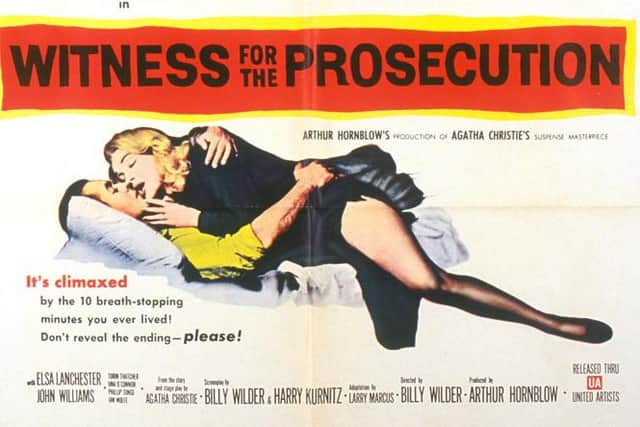
There are many reasons the TV adaptation – and various stage versions – do not not match up. The mastery of director Billy Wilder being one of them.
Hard as it is to imagine for those who revere ‘influencers’ eating cockroaches in a jungle, the cast is towering and content scandalous.
The sultry, smouldering, exotic, husky-voiced Marlene Dietrich paired with matinee idol and screen swashbuckler Tyrone Power was movie majesty. The older woman and a younger man was powerful stuff in 1957. It was years before the words ‘cougar’ or ‘toy boy’ were used to describe the dynamics of relationships.
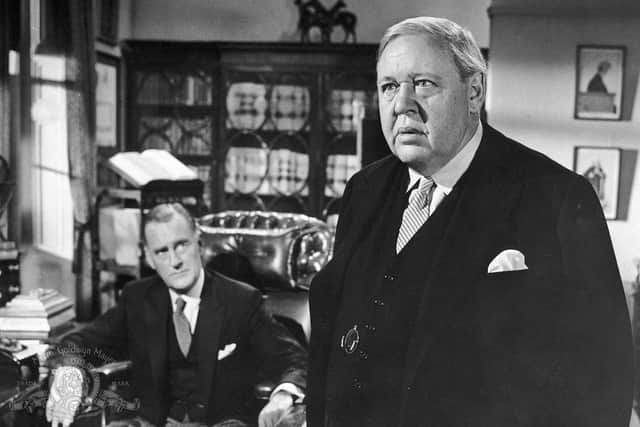
Most of all, the towering presence that was Oscar-winner Charles Laughton. A book is needed to pay proper homage to the English actor who, from being the son of Scarborough hoteliers, became one of Hollywood’s most feted stars.
No one else looked like Laughton, none had his deep-toned voice and no one else moved like him. He was protean as Quasimodo in The Hunchback of Notre Dame, tip-toeing round the cathedral belfry, swinging from ropes and crying out in anguish.
His range was huge – costume drama and tragedy to murder-mystery and comedy. He won an Oscar for The Private Life of Henry VIII and was nominated for Witness for the Prosecution and Mutiny on the Bounty.
His malleable features, too, could do anything. They flickered between malice and mischief. He could break your heart – the cowardly schoolmaster in This Land is Mine – and put fear in there too – as the cruel Captain Bligh in Mutiny on the Bounty and the malevolent father in The Barretts of Wimpole Street.
It is to Wilder’s credit that he reins in Laughton so he does not steal the picture from Dietrich or Power but he comes dangerously close.
He looms large over the proceedings as the irascible, flamboyant, curmudgeon defence barrister Sir Wilfrid Robarts, called in to keep Power’s character Leonard Vole from the gallows. Ten years earlier, he had played a similar – but lewder – character in Alfred Hitchcock’s The Paradine Case.
Laughton revelled in the comedy of Witness in the form of the relationship with his private nurse Miss Plimsoll, played by his real-life wife Elsa Lanchester. The chemistry between them is perfection. There was a lovely cameo from Una O’Connor as the murdered woman’s housekeeper. Her turn in the witness box was five minutes of magic.
As the credits roll at the end of the film an announcer pleads: “The management of this theatre suggests that, for the greater entertainment of your friends who have not yet seen the picture, you will not divulge to anyone the secret of the ending of Witness for the Prosecution.”
No spoilers here, either. I revel in the parry and punch that leads to an explosive ending. The first time I saw it, I was gobsmacked at the denouement.