
Talks underway to manage growing population at Billing Aquadrome after latest flood evacuation

Officials are rethinking how to handle the growing population at flood-hit Billing Aquadrome after the latest evacuation.
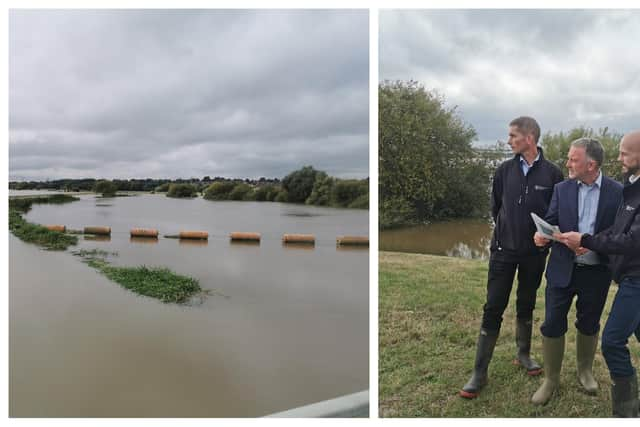
Holidaymakers and residents at Billing Aquadrome were evacuated last night (Tuesday) following severe flooding at the holiday park. The flooding, caused by unprecedented rainfall, has prompted a visit to the Northampton Washlands by Secretary of State for the Environment Steve Reed and officials from the Environment Agency, where they discussed the immediate response and future plans for flood management.
Speaking to Chronicle and Echo, Secretary of State for the Environment Steve Reed said: “We’ve seen in the last couple of days in some places, a month’s rain come down and that’s caused flooding, so we’ve had schools that have had to close or partially close, businesses that are affected, people have been flooded out of their homes as well. I’ve come down here to make sure the agencies are providing the support that’s necessary for people.
"In the past, we noticed that funding we’ve had allocated to build better flood defences was sitting in a bank rather than being spent. So I’ve set up a flood resilience task force. I chaired the first meeting for that a couple of weeks ago. Its purpose is to make sure we coordinate better between the centre, where the money is held, and the agencies on the ground to ensure allocated funding is spent to keep people safer from flooding.”

When asked how much needs to be spent, he said: “For once, this isn’t an issue about lack of funding. We have to make sure that money – for barriers along rivers, for drainage that can divert flood water away from communities – is actually being spent, because in some cases it was just sitting in banks for years.”
When asked how soon the funds can be implemented, he said: “We set up a task force two weeks ago, just weeks after being elected, so we can get to work straight away. It can’t happen overnight unfortunately... but we’re focused on it right now to make sure we can move it ahead as quickly as possible. We’ll be working with the local authority and Environment Agency to make sure where things can be speeded up locally."
On climate change, he said: “What we’re seeing around me – fields flooded out, homes flooded out – this is a direct result of climate change. We’re getting much more frequent weather events. The Government is taking action on that.”
Ben Thorley of the Environment Agency echoed the concern, saying: “During this rainfall incident, we saw two months of rain in two days. Over 13cm of rain fell. The challenge with that is a lot of surface water flooding and the ability of that water to get to the river to discharge. We saw very high river levels, we saw high amounts of surface water flooding across the county and the challenge is, the drainage infrastructure is not designed to take that volume of water in such a short period of time. Consequently, properties were flooded, either from surface water flooding or river flooding. What we’re doing is working as multi-agency partners... firstly, in terms of our response to those incidents, but also to look at opportunities to try and reduce the frequency of these incidents in the future. One of the big challenges we have is climate change as we’re seeing warmer summers and wetter winters.”
When asked if the flood gates had been opened quick enough, he said: “Northampton Washlands Reservoir is a flood storage reservoir that allows us to control the amount of water flowing downstream from Northampton and allows us to store the water that is coming through Northampton. We had hotspots where the water couldn’t get to the river quickly enough or the river channels were exceeded and there was too much water for the channels. For example, in Dallington, the flood storage reservoir filled to capacity and at that point there was an increased flow going downstream and very sadly properties were affected.”
When asked if Billing Aquadrome would be given planning permission today, he said: “The challenge we’ve had at Billing Aquadrome is the intensification of the site has changed over the years. And as parts of the site are located on a floodplain, it’s those parts of the site that are most affected. So when we see very high levels, as we’ve experienced in the last few days, the floodplain goes into operation and that’s when the multi-agency partnership works with the management of the Aquadrome to evacuate people from the site. In terms of the future of the Aquadrome, that’s something we need to talk about with partners in terms of how best to manage the amount of people that are now located on the park.”
When asked if the problem is too big to undo now because Billing has grown so much, he said: “The Aquadrome has developed over the years and the use of it has intensified, so therefore it’s something we need to work with WNC and other partners to look at and understand how best to manage that in the future.”
When asked about talks with the Billing Aquadrome owners [Meadow Bay Villages] and the council, he said: “The last two days the focus has been about the evacuation and the here and now of reducing risk to life.”
When asked if the Government is doing enough to protect the site, he said: “There is a lot of talk with the new owners of the site as to how best to manage it, and a lot of work between the multi-agency partners to understand how we can reduce the risk to life going forward.”
WNC and Meadow Bay Villages have been contacted for comment.