
Northamptonshire hypnotherapist calls on employers to recognise the strengths of dyslexic staff
Hypnotherapist and workplace wellbeing practitioner Frances B. Lafferty is encouraging employers to look beyond spelling and paperwork and recognise the experience, imagination and problem-solving that dyslexic employees can bring to work.


Frances is sharing her experience ahead of Dyslexia Awareness Week, which runs from 5 to 11 October 2026. The British Dyslexia Association has chosen the theme Dyslexia in real life: At work, focusing on how recruitment, communication, workplace systems, management and access to adjustments can affect dyslexic employees.
Diagnosed with dyslexia at around seven or eight years old, Frances found that difficulties with reading, spelling and putting her ideas on paper often affected her confidence. Her experience also revealed strengths that later became central to her working life: imagination, verbal communication, practical problem-solving, empathy and the ability to see situations from a different perspective.
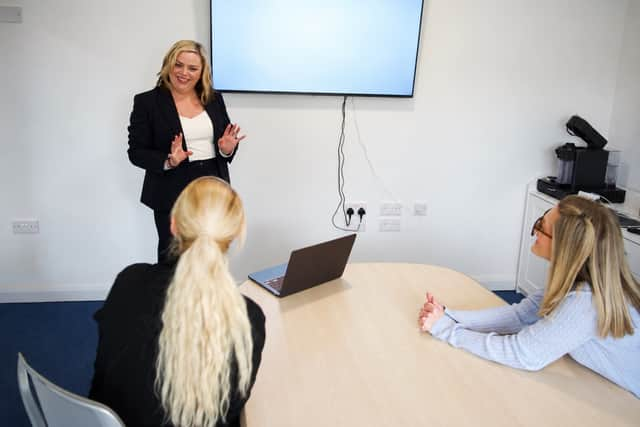
"Dyslexia did not disappear when I left school. It came with me into job applications, training, emails, meetings and presentations," Frances said. "I may need to read something more than once, hear information aloud or use technology, but that does not make me less capable. My brain works differently, and that different way of thinking can be a real strength at work."
Frances worked in ground handling at a local airport from 2007 to 2015, undertaking roles in check-in, customer service, apron driving and aviation safety. After moving to Northamptonshire in 2015, she worked in healthcare until 2021 and later moved into health and safety. She now runs Lafferty Hypnotherapy in Long Buckby, supporting individuals and organisations with stress, anxiety, confidence and workplace wellbeing.
Her journey was not always straightforward. While completing a person-centred counselling diploma in Derry between 2010 and 2012, Frances could explain the subject verbally and passed her exam, but struggled to translate her understanding into written coursework. Although she received extra time and access to reading, proofreading and assistive technology, the experience damaged her confidence and affected how she viewed her abilities for almost a decade.
Learning hypnotherapy later helped Frances challenge the belief that she was not good enough. She went on to qualify as a hypnotherapist, establish her own practice, speak at the UK Hypnosis Convention and the Irish Hypnotherapy Conference, and appear on BBC Radio Northampton.
"For years, I thought struggling with written work meant I was not intelligent enough," Frances said. "What I understand now is that I often need a different route to show what I know. Good support is not about lowering standards. It is about removing unnecessary barriers so people can use their abilities."
Frances says she has also been fortunate to work with employers who recognised her dyslexia as a source of creativity and different thinking rather than treating it only as a difficulty.
"My entire career has been about safety - first physical safety and now psychological safety," she said. "People do their best work when they feel able to explain what they need without embarrassment. A supportive manager can make the difference between someone hiding their difficulties and someone contributing with confidence."
Practical Support at Work
Frances encourages employers to ask each person what helps them work effectively. Useful support may include providing important instructions in both written and verbal form, allowing time to process complex information, making assistive technology available and checking understanding without causing embarrassment. She also urges managers to notice an employee's wider contribution rather than judging capability through spelling or written speed alone.
The official Dyslexia Awareness Week campaign says dyslexic employees bring valuable skills, experience and different ways of thinking, while poorly designed workplace systems can create barriers that prevent people from showing what they can do.
"I hope employers use this week to listen to dyslexic staff and recognise what they bring," Frances said. "Needing to do something differently does not mean a person is less capable. With understanding and the right tools, dyslexic employees can contribute, develop and thrive."