
Wonder Boy review - Story of stammering is messy but full of heart and invention on Northampton stage
Lily Canter reviews Wonder Boy at the Royal & Derngate, Northampton
What happens when you can’t even say your own name? This is the profound question at the emotional heart of Wonder Boy.
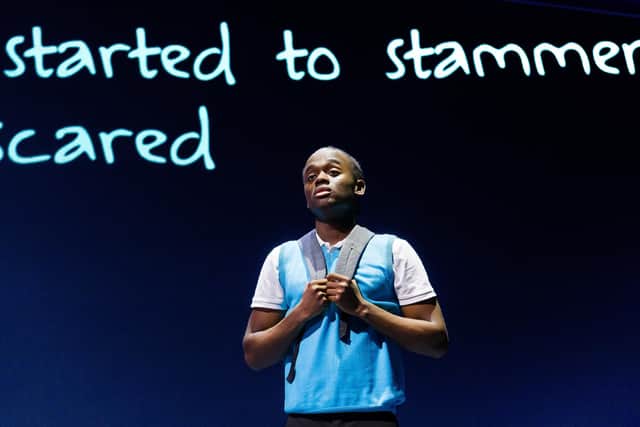

The unflinchingly honest exploration of growing up with a stammer is a vibrant and visual 90-minute rollercoaster ride.
Written by Ross Willis and directed with bold thematic flair by Sally Cookson, the play captures the relentless self-loathing, shame and frustration that often accompany stammering.
Through the embittered eyes of 12-year-old Sonny it delves into the daily challenges of navigating a world built on words, from the constant fear of speaking to the painful betrayal of body and brain when the simplest phrases won’t come out.
In his professional debut Hilson Agbangbe gives an astonishingly mature performance as Sonny lashes out in grief and exasperation to those that seek to help him.
Along for the ride is troubled, misunderstood teen Roshi (a remarkable Naia Elliott-Spence), who pours out a stream of consciousness at 100 miles an hour.
Eventually finding solace in the classroom of potty-mouthed teacher Miss Wainwright (Eva Scott), Sonny gradually faces his fear as he is forced to take part in a school production of Hamlet.
While Wainwright is the heart of the piece, bureaucratic headteacher Miss Fish (Jessica Murrain) is more interested in paper-pushing than engaging with pupils.
Framing the narrative is imaginary figure Captain Chatter, dreamed up by Sonny in his comic-book drawings. While he starts the plot with a burst of energy, he soon disappears into the background, lost among all the corridor chatter.
The remarkable set is designed to mimic a comic-book style with lighting effects creating a neon border and pop-art visuals bursting onto the background screen every time Captain Chatter appears. But the biggest nod to comics is the actors’ words captioned in different fonts creating a sense of live speech bubbles.
Many of these words are foul language, and for a suggested 12 rating, the script is alarmingly filled with profanities. This seems quite excessive at times and the reasoning is not entirely clear. If it is meant to reflect realism then by the same token why are there no mobile phones or special educational needs departments?
In many ways this is a play stuck in another time albeit with universal themes. It’s a shame then that the underlining motifs of mental illness, the broken care system, disenfranchised youth and failing schools does get a little lost and confused among all the text.
Fortunately, the piece is held together by the immense pathos felt for Sonny and the career-breaking turn by Agbangbe.
Less successful are some of the periphery characters with Captain Chatter a baffling mix of friend and foe. One minute he is Sonny’s alter ego helping him to soar through the air and the next he is anxiously telling him to keep quiet. Is he an enabler or a prohibitor? By the end he seems to be nothing but an irrelevant player in Sonny’s adolescence.
Even more jarring is the bizarre Miss Fish who has a fixation with cats which is neither funny nor makes narrative sense other than to ram home the message that she cares for her feline companions more than her pupils.
Much like Sonny’s inner monologue, Wonder Boy is contrary and messy but bursting with clever ideas and plenty of heart.
Wonder Boy ran from November 21 to 23. Visit wonderboyplay.com for more information about the play.