
‘We have to keep telling these stories’: Inside Breaking the Code as Turing play comes to Northampton
Director and lead actor of talk about the remarkable life of the genius
Alan Turing was a brilliant mathematician, best known for his work at Bletchley Park, breaking the Enigma code used by Nazi Germany in the Second World War – but also a pioneer within the fields of computing and Artificial Intelligence. In 1952, Turing was convicted of gross indecency for having an affair with a young man, and was sentenced to chemical castration, forced to take hormones. He died from cyanide poisoning in 1954.
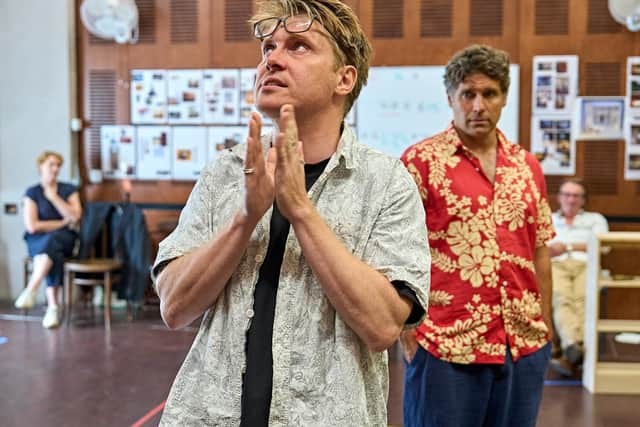

In 1986, Hugh Whitemore play about Turing, Breaking the Code, was first staged at the Theatre Royal Haymarket in London before transferring to Broadway; in 1996, it was made into the TV film, starring Derek Jacobi. This autumn, artistic director of Northampton’s Royal & Derngate Jesse Jones directs a new production of Breaking the Code, with Mark Edel-Hunt playing Turing. Here, they discuss the play – and why Turing’s story is as inspiring and relevant as ever.
What can audiences expect from Breaking the Code?
Jesse Jones: It's a portrait of somebody we associate with having done one main thing – breaking the Enigma code – but it delves into his life and his relationships in a very human way. It's funny at times. It's heartbreaking at times. And it really does the job of making him human. It breaks the code of him a little bit, I suppose.
Do you think Turing’s life and work still deserves to be better known?
Mark Edel-Hunt: For me, while homophobia exists, we have to keep telling these stories. That's one reason why we have to keep shouting about it. And the other thing is we are living in a world where AI is hurtling towards us – and Alan Turing was the first person to really daydream about a computer that could think for itself. AI is going to profoundly change what ‘thinking’ is – and being around Alan might help us start to understand what AI might mean, and how we should handle it.
The conversation about AI really is moving terrifyingly fast – do you think it makes this play seem particularly pertinent?
Jones: Yeah, I do. Those words get louder and louder in the play. The play is not about AI, but inadvertently, the question of morals, of right and wrong, folds into the AI conversation – around who is in control of it, and who we want to be making decisions for us about it.
What do you think Turing would have made of us all having a computer with AI on it in our pocket?
Jones: I think he probably would've said, I told you so! There's a passage in the play that says, ‘by the year 2000, I don't think it would be unusual to speak about an intelligent machine that can think and feel’. So he might even go, what took you so long?
Edel-Hunt: He was excited by the idea of creating a machine that could think for itself, and so you would think Chat GPT or whatever would be exciting to him. On the flip side, as I get to know Alan a bit better, he was also someone who was really energised and delighted by the deliciousness of human thinking. And in a sense, AI's helping us not to think anymore; it's going to do the thinking for us. And I wonder how he would feel about that.
The story of the cracking of the Enigma code is remarkable – but the play is also so much about Turing’s personal life. How are you finding the balance of those?
Edel-Hunt: If Alan was sat here, he'd be the first one to remind us that he didn't do it on his own: I think he'd be dismayed at the idea of being heralded as the man who single-handedly broke the Enigma code. And he believed passionately in his work, but he wasn't interested in celebrity. But that tension between what the establishment wanted him to be and who he actually was is really what the whole play is about. He was a brilliant mind, and yet he couldn't fully be that mind because he lived in a world that was going to punish him for being who he was. That tension is what drives the whole play.
Has there been anything that you've discovered about Turing while working on this that surprised you?
Jones: I think because of some previous interpretations of him, [I was surprised by] his cheekiness, his charm, his sexiness… He's really funny. He's really direct, and sometimes rude. But that's the picture of a human being, and that's beautiful.
Edel-Hunt: There's a lazy assumption that because he's good at maths, he's a geek and he's socially incapable. And actually, when you read his letters, he's witty, he's quick, he's engaging. And also, he's sexually active: he is a man who has sex with other men, he's not just sat in some dusty room. So that was a fun thing to discover.
In the play, Turing is unapologetic about being gay, and has a very rational attitude towards his sexuality. Do you think that will speak to us today?
Jones: I really do. It takes incredibly brave people to speak their truth for us to be able to move the goalposts of how accepted we can all be in society. It's not easy for Turing to live the way that he wants to, but he cannot pretend to be something else. And that's a lesson there – that is an important thing for all of us to hold onto.
Edel-Hunt: Homophobia, misogyny, racism – they are irrational feelings. And because Alan was a hyper-rational creature, he wouldn't let that go. I guess the depressing part of rehearsing this play is that, yes, things have changed, but sadly whether it be 1952, 1986 when the play was written, or now, that irrational feeling still exists. I think Alan would be rather surprised by that: that we can make AI, but we still sometimes think that being gay is wrong!
Breaking the Code runs at the Royal & Derngate from September 11 to 27. Call 01604 624811 or visit www.royalandderngate.co.uk to book.