
Astronaut Tim Peake on the history and future of space travel ahead of Northampton show
British astronaut Tim Peake will blast off across the country this autumn – and he’ll be stopping off in Northampton to share some remarkable stories of space travel.
Tim made history in 2015 when he became the first British astronaut to visit the International Space Station (ISS), where he spent six months living and working in space, completing a spacewalk and even running a marathon.
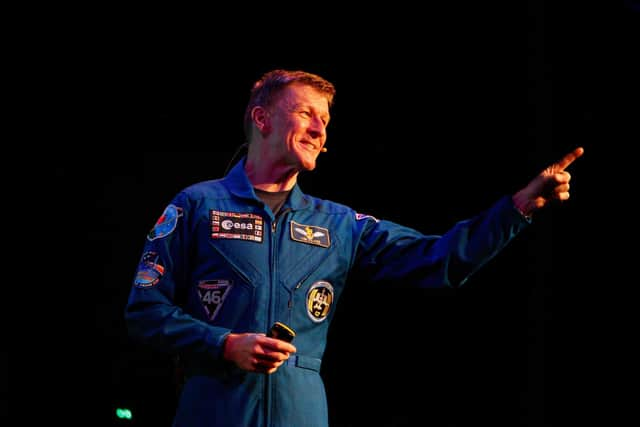

And now he’s looking forward to a potential return to space, as part of a commercially sponsored, UK mission which could see him return to the ISS.
His tour, Astronauts: The Quest To Explore Space, brings to life the adventures of astronauts in a celebration of human spaceflight and gives a fascinating insight into what lies ahead.
“It’s like the greatest hits of space exploration, with amazing footage and behind the scenes stories of what it’s really like to leave our planet,” Tim said.
Tim will look back on the history of human space exploration. “This tour is fast-paced, fun and entertaining,” Tim promises. “It showcases the extraordinary endeavour of human spaceflight – the excitement, the drama, the highs and lows, right from the early days of the 1950s, through to the current Artemis program to return to the Moon, and beyond to the first human mission to Mars.
“There are around 650 people who have been into space – and this tour allows me to share some of their many amazing stories of human spaceflight. Looking back at the amazing endeavours through the years to create this show has been incredible.
“I am so honoured to have experienced the wonders of space travel myself, and yet it still continues to amaze me just how much space inspires and fascinates people of all ages – and the show’s Q&A section proves that every single night. I love that part, but it’s also slightly terrifying as you never know what people are going to ask.”
So what does life look like now? “Realistically, with a career like this you don’t ever completely retire. I have been to events like the Starmus Festival a few years ago, where I had the privilege to meet several of the Apollo astronauts – from Charlie Duke to Buzz Aldrin. They are still out there promoting science, space and exploration and I hope I’ll do the same.
“Travelling to space gives you a unique perspective and I still enjoy sharing it.”
These are momentous times for the space industry. While a moonwalk is on the cards for the Artemis 3 crew in 2027, and work is ongoing towards a crewed mission to Mars, some of the most exciting work will have impacts much closer to home in the coming years.
“We have occupied the ISS for nearly 25 years now – and it is essentially a giant science lab,” Tim explains about the research taking place in orbit. “There are components in modern mobile phones which were first tested on the ISS.
“But we’re getting more specialist in the science taking place there now. There is more targeted pharmaceutical research as companies realise the potential available to them. For example, growing protein crystals in space for motor neurone and Parkinson’s diseases could lead to much better treatments for these conditions.
“We’re at the stage where space can become a manufacturing hub for all sorts of things, which can then be brought back down to earth.
“There are things you can build in space which can’t be built on earth, because of the effects of gravity, and with costs coming down we can also think about large scale manufacturing in space.
“There are attempts to grow human tissue and organs such as a heart on Earth, using bio ink and 3D printers. The problem is that small structures collapse due to gravity and need some sort of scaffolding. It’s not very effective. But in space, you can 3D print human organs more easily, because there is no gravity causing them to collapse in on themselves.
“It sounds like the wildest science fiction, but it really is science fact and it’s where we are at right now. In five to ten years, we could be printing full-size human organs in space that could be a feasible transplant option for patients. And that’s when space research starts to mean something very real for people on Earth.
“The potential is only just now being unlocked – and with the shift from purely government-funded research to commercially-funded opportunities, there is greater competition to achieve results.
“Of course, there is the caveat question: Should we send lots of rockets up into space, when we think about the debris from launches and space pollution? But many space companies, some of whom I am working with, are also out there focusing on that clean-up effort, the removal of space debris and creating cleaner, more efficient rocket fuel.”
While all these prospects for the future of space travel are without doubt exciting, what most drives Tim’s enthusiasm is the power of inspiration.
Some of the scientists and engineers coming through now were teenagers inspired by his Principia mission – which has created a huge legacy for the British space industry.
“It’s easy to be inspired by space,” he said. “You go to a conference, meet companies doing incredible things. I can’t help but be inspired still by the potential future opportunities.
“The legacy I’m most proud of from my mission is without doubt the inspiration for future generations. When I go to schools and colleges, it’s amazing to see older students saying ‘I remember watching you launch and you inspired me to go off and follow these subjects’.
“It’s a huge privilege to have a platform that allows you to inspire people. Space is a place where we can all wonder and dream.”
Tim Peake comes to the Royal & Derngate on Monday September 22. Visit nothird.co.uk/live-shows/tim-peake to book.