
Common reasons why your car parts keep coming back


Your car is making a noise. You order what seems to be the right part. It arrives. It doesn't fit. You return it and order another one. Wrong again.
Three weeks and multiple deliveries later, you finally have the correct component – except now something else has broken because you've been driving with the original problem for a month.
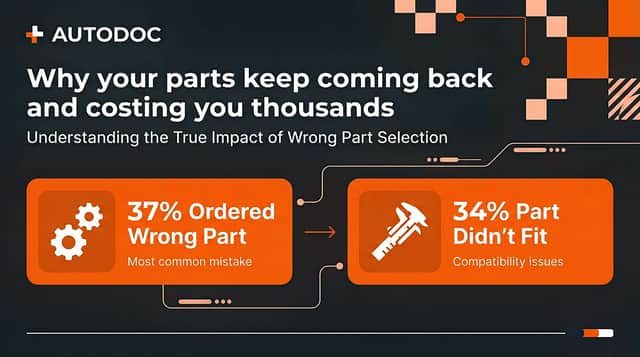
Sound familiar? You're not alone. AUTODOC, a leading European online automotive parts retailer, analysed their returns data and discovered something remarkable: 37% of customers ordered the wrong part entirely. Another 34% discovered that their 'perfect match' didn't fit. That's 71% of returns happening before the part has even been touched. When these mistakes make it to the installation stage, minor repairs can turn into significant expenses.
Fatal mistake number one: ignoring the VIN or OEM numbers.
Your mate down the pub swears his brake pads will fit your Focus. You've got the same year, model and colour. You order them. They arrive. They don't fit.
Welcome to the most expensive guessing game in motoring!
A 2015 Ford Focus isn't just one vehicle it could be any one of dozens of variants wearing the same badge. Three different engines. Multiple gearbox options. The suspension was revised halfway through the production year. The Focus built in March has different mounting points to the one built in November. It has different brake caliper pistons. Different sensor connections.
Your VIN reveals the full story. Those 17 characters contain the actual specifications of your car as it left the factory, not what the marketing brochure promised, but what is genuinely bolted together under your bonnet. Mid-year updates happen constantly. Manufacturers improve components, change suppliers and modify designs. The catalogue doesn't always keep up.
OEM numbers cut through the confusion. The alphanumeric code stamped on your existing part is its unique fingerprint. Cross-reference it before ordering to eliminate the guesswork. Skip this five-minute check and you're gambling on a 37% chance of ordering something useless. You've just gambled on a 37% chance of ordering something useless.
The consequences go beyond returns. Fit the wrong alternator, for example, and you might damage the new unit during installation. Incorrect engine mounts can cause vibrations that crack other components. Incorrect sensors can produce error codes that mask genuine faults developing elsewhere. You've created problems that didn't exist before you started 'fixing' things.
Fatal mistake number two: choosing the cheapest option solely.
Bargain-hunting works brilliantly for screen wash. But what about brake components? You're playing Russian roulette with your family's safety.
A case from a UK motoring forum illustrates this perfectly. A driver spotted brake discs priced 40% below normal. They couldn't resist. Within thousands of miles, the substandard metallurgy revealed itself in the form of excessive wear, warping and damaged calipers. The final bill for a complete brake system rebuilds? Much more than the initial 'saving'.
Cheap parts fail in predictable patterns. Budget timing belts use inferior rubber compounds that crack prematurely. When they break, the engine valves collide with the pistons at high speed. That's not a repair, it's a rebuild. Bargain suspension bushings deteriorate within months, causing misalignment that can destroy a fresh set of tyres. Economy wheel bearings seize, which can damage hubs and potentially lock the wheels mid-corner.
Nobody's suggesting you buy the most expensive option. However, critical safety components such as brakes, steering, suspension and timing systems deserve mid-range parts from well-known manufacturers. You're paying for tested metallurgy. You're paying for quality control that catches defects. You're paying for engineering tolerances that actually match OEM specifications.
The true cost calculation also takes into account how long the part lasts and the damage caused when it fails. Premium dealer prices are often not justified. However, neither is taking a risk with unknown manufacturers who have cut every possible corner to hit that tempting price point.
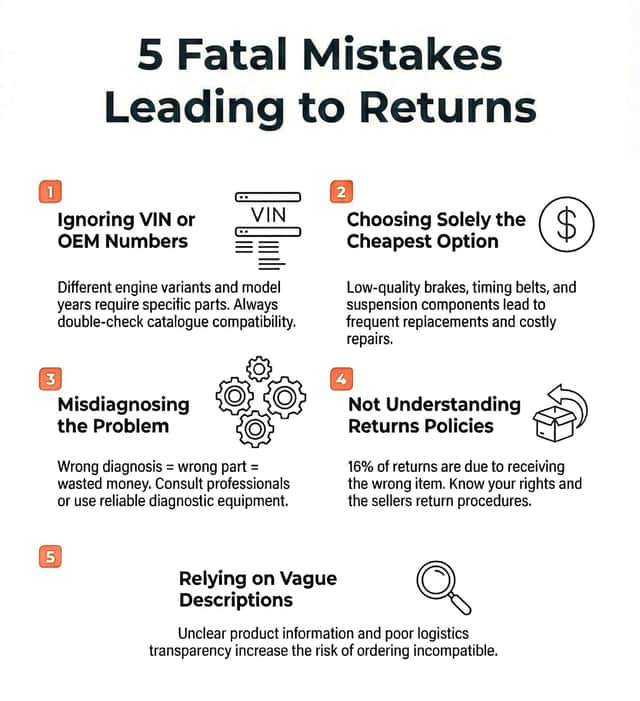
Fatal mistake number three: misdiagnosing the problem
Throwing parts at symptoms is an expensive form of guesswork that is dressed up as maintenance.
Your engine is running rough. It could be the spark plugs. It could be the coil packs. It could also be injectors, a vacuum leak, a faulty mass airflow sensor or contaminated fuel. If you replace the spark plugs based on a hunch, you've wasted money while the actual problem continues to destroy other components.
Modern vehicles contain dozens of interconnected sensors. Symptoms can be misleading. For example, an ABS warning light could indicate a faulty wheel speed sensor, damaged wiring, a failing pump, corrosion on a connector or even a blown fuse. Without reading the actual fault codes and testing systematically, you're just guessing.
Although diagnostic equipment costs thousands, you don't need to buy it. Many parts retailers offer free code reading. Independent garages charge modest fees for proper diagnosis. It is better to invest in professional diagnosis than to spend money on the wrong part, then pay again for the correct one, plus labour for two separate fitting sessions.
Even fault codes need to be interpreted correctly. For example, a stored code for an oxygen sensor could actually indicate an exhaust leak that is affecting the sensor's readings. Experienced mechanics use codes as a starting point for methodical testing rather than as definitive answers. If you lack this level of expertise, consult someone who can verify the diagnosis before committing to purchasing parts.
Meanwhile, the real fault will worsen. Small coolant leaks can lead to warped cylinder heads. Minor electrical issues evolve into burned-out ECUs. Accurate diagnosis comes first, ordering parts second.
Fatal mistake four: not understanding the returns landscape
The Real Cost of a Mismatch: Why Parts Go Back
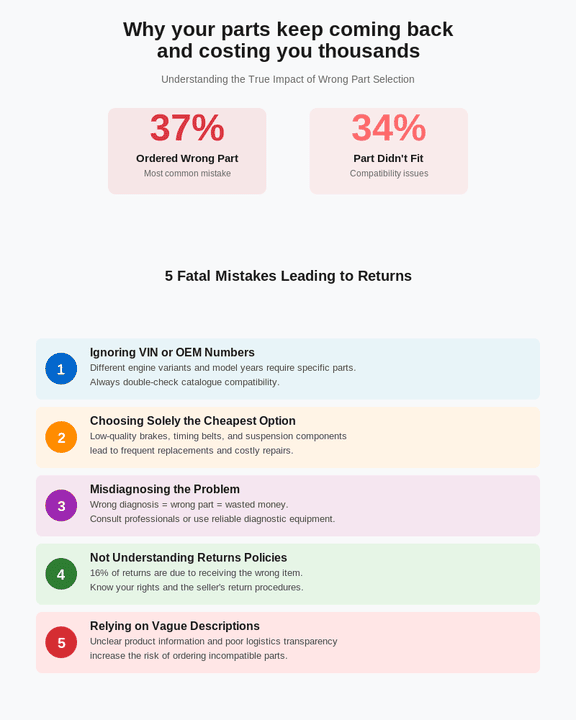
The 71% returns figure from AUTODOC reveals what most drivers learn too late: you only understand return policies when you desperately need them.
Policies vary wildly. Some retailers charge restocking fees of 15–25%. Others refuse returns on electrical components once the packaging has been opened. Time limits range from 14 to 90 days. Sale items? They are often entirely non-returnable. The fact that 16% of returns are caused by sellers sending the wrong items proves that even when the error isn't yours, you still have to deal with bureaucracy while your car is out of action.
Before clicking 'buy', verify the boring details. Who pays for return shipping? How quickly are refunds processed? What documentation must you keep? Original packaging matters - many retailers refuse returns without it. Take photographs of part numbers before installation. Keep order confirmations, invoices and everything else.
If you have already installed parts before realising they are wrong, you will incur labour charges for removal that cannot be recovered. This is money lost due to mistakes that could have been prevented by proper checking.
This is connected to customer feedback cycles. Recent data from over 69,000 customer responses, as highlighted by Lennart Schmidt on LinkedIn, shows that major retailers are constantly improving their processes based on user experience. Better systems mean fewer dispatch errors and clearer compatibility information, as well as smoother returns when problems occur.
Choose retailers whose infrastructure suggests they have invested in getting orders right the first time. Friction in the returns process increases your costs through delayed refunds, additional shipping charges and lost transport time.
Fatal mistake number five: relying on vague descriptions and product availability.
'Fits 2015–2019 models.' Which engine? Which trim level? Which market? Is it European spec or UK domestic? Does it have electronic suspension? Manual or automatic gearbox?
Vague listings force you to assume compatibility. Such assumptions can be expensive.
Proper specifications eliminate ambiguity. Brake calliper listings should state the positioning (e.g. front left or rear right), the number of pistons and compatibility with specific brake diameters. Suspension components must specify whether they are suitable for vehicles with standard or electronic damping. Anything less is just guesswork in the form of a sales description.
Logistics transparency is more important than most drivers realise. When retailers operate substantial warehouse networks, inventory accuracy improves and order fulfilment becomes more reliable. AUTODOC runs four large warehouse locations across Berlin, Szczecin, Cheb and Ghent, and their state-of-the-art facility in Belgium is set to open in 2025. This level of infrastructure isn't about speed; it's about accuracy.
Sophisticated warehousing uses barcode scanning and automated picking and verification steps to catch human error before dispatch. Smaller operations that rely on manual processes tend to send out incorrect items more frequently. When comparing suppliers, consider operational scale as an indicator of likely accuracy.
Availability information must be specific. 'Usually ships within 3–5 days' are meaningless when urgent transport is required. Knowing which warehouse holds stock and what the realistic delivery timeframe is lets you plan accordingly. Vague availability information often signals inventory management issues, which correlate directly with higher error rates and discovering that parts are out of stock after ordering.
Your action plan
UK drivers spend considerable sums annually on vehicle maintenance and repairs. Multiple mistakes across a year of failed cheap components requiring early replacement, incompatible parts from misdiagnosis, wrong-part returns with restocking fees can significantly increase those costs.
Establish a systematic approach. Before ordering anything, locate your VIN and the OEM numbers stamped on existing components. Cross-reference both against catalogue specifications. For critical components, resist cheap options research mid-range alternatives from established manufacturers. Invest in proper diagnosis using fault code reading and systematic testing. Review return policies before checkout. Demand detailed specifications and transparent availability information.
When you're ready to order, ATD UK customers can save 5% on purchases over £100 using the code northamptonATD at checkout. The offer runs until 15 January 2026.
Five decision points separate smooth repairs from expensive disasters. Choose carefully, verify thoroughly, prioritise compatibility over convenience. Your bank balance depends on it.