
WNC responds to concerns about two major roads in Northampton which YOU said need urgent repair due to pothole damage

West Northamptonshire Council (WNC) has responded to concerns about two major roads in Northampton which YOU said need urgent repair due to pothole damage.
Readers have told us on social media that Crow Lane and the A4500 near Upton are currently in a terrible state. Chronicle & Echo went down to take a look and can confirm they are both in poor condition.
Given these are two incredibly busy routes used by thousands of motorists every day, this newspaper asked WNC what is being done.
The Reform-led administration responded with comments previously issued on the pothole situation.
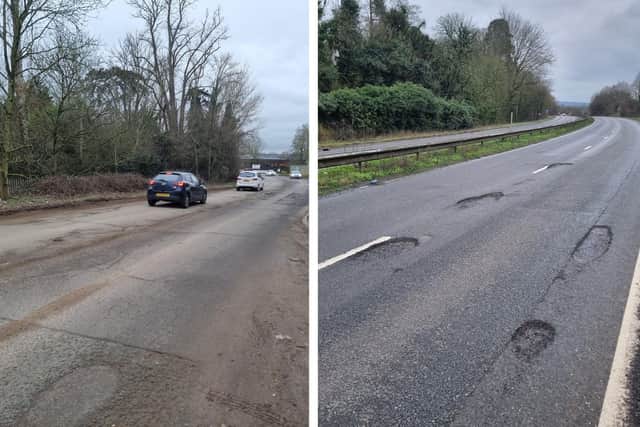

A council spokesman said: “West Northamptonshire’s road network is currently facing significant pressure following a prolonged spell of wet weather combined with extended freezing conditions.
“This mix of saturation and frost has caused widespread and accelerated deterioration across many parts of the network.
“While large sections are already scheduled for preventative and permanent repairs, those works rely heavily on suitable weather windows and planned road closures. In the meantime, some roads are deteriorating faster than they can be inspected or proactively treated.
“Because of this, the rate of new defects emerging across the network is outpacing our ability to respond in the usual way. Our highways teams are having to make difficult but necessary decisions about where they focus their efforts – balancing immediate safety risks with what is realistically achievable in the short term.”
The A4500 between the Sandy Lane Roundabout and the Millfield Way Roundabout was closed overnight on Tuesday February 17. Lanes were also closed for a number of hours on Thursday February 19. Both closures were for essential repair works.
Reform councillor Richard Butler, cabinet member for highways and transport, added: “Recent wet and freezing weather has caused rapid deterioration across the road network, so we’re prioritising the most urgent, safety-critical repairs.
“In some areas, our crews are carrying out temporary emergency patches to make locations safe quickly, and they’ll return to complete more permanent repairs as soon as conditions allow.
“Some of these issues occur very quickly and we’re asking everyone to report any they’re aware of. Please don’t assume we already know about them.”
The council spokesman continued: “At the moment, our priority is to address the most urgent safety issues caused by sudden damage. Many of these emergency repairs are temporary by design. They allow us to make a location safe quickly before our teams return to deliver longer-lasting, permanent solutions once conditions allow.
“This approach is sometimes misunderstood as a failed or short-lived repair, but the reality is that temporary treatments are an essential tool in managing severe network pressure. They enable us to keep roads safe and open while more substantial works are scheduled and carried out.
“A recent example demonstrates how quickly situations can change. Near Abthorpe, permanent repairs were already planned for January 26 – 27, but new damage emerged ahead of this schedule. Thanks to a report submitted through Fix My Street, our highways team were able to escalate the issue immediately, deploy emergency crews, and make the area safe before the planned works took place. These rapid interventions simply wouldn’t be possible without real-time reports from the public.”
The spokesman added: “At a time when the network is experiencing such high levels of strain, public reporting is vital. This can be done via the West Northamptonshire Council app, our website, or Fix My Street, and helps us spot newly emerging issues quickly, assess the severity, and prioritise repairs based on safety.
“We cannot be everywhere at once, but with continued support from residents, we can ensure that the most urgent issues are addressed as swiftly as possible. Every report helps us keep the network safe and ensures our teams are deployed where they are needed most.”