
Voi responds after leader of West Northamptonshire Council warns Northampton's e-scooter trial is in ‘last-chance territory’

Voi has responded after the leader of West Northamptonshire Council (WNC) warned the town’s e-scooter trial is in “last-chance territory" amid growing concerns over dangerous riding and anti-social behaviour.
The operator said more than 6.25 million journeys had been made on Voi e-scooters since the scheme launched in Northampton in 2020, helping thousands of people travel to work, education and local high streets.
A Voi spokesperson said: “We are very grateful to have operated here for almost six years and for the council’s decision to extend the scheme.
“We take the concerns raised by councillor Arnull and others extremely seriously. Working closely with the council, we are putting in place further improvements so that the e-scooter scheme works not just for riders, but for the whole community.

“Once this plan is agreed with the council, we will publish it so residents can see exactly what will change and how we are improving the scheme.”
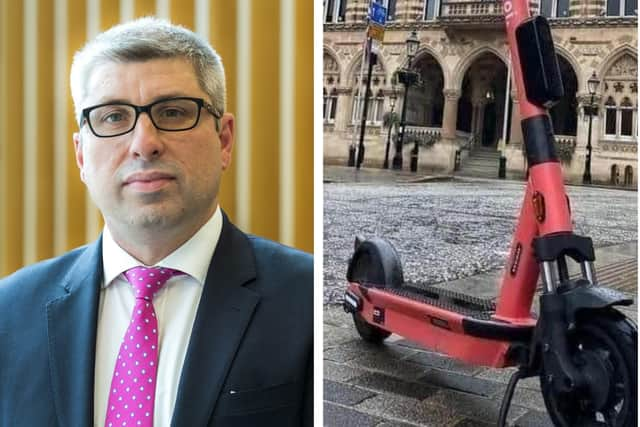
The response comes after Councillor Mark Arnull, Reform UK group leader and leader of WNC, recently issued a strongly-worded statement in a column to the Chronicle & Echo following the extension of the town’s public e-scooter trial.
Councillor Arnull said the extension did not amount to “a free pass for illegal or dangerous behaviour” and warned that public patience with the scheme was “wearing thin”.
He said: “When the public e-scooters scheme first arrived on the streets of Northampton, residents were told this was a trial. A chance to see whether new transport technology could be introduced safely, responsibly and with respect for our town and the people who live in it.
“That trial has now been extended. Let me be very clear about what that means.
“It does not mean a free pass for illegal or dangerous behaviour. It does not mean tolerating scooters on pavements, ignored parking rules, or riders treating one-way streets as optional. And it absolutely does not mean residents, particularly older people, disabled people, and parents with young children being made to feel unsafe in their own town centre.
“The list of problems is not theoretical. Councillors and officers have repeatedly raised very real concerns around dual riding, pavement riding, dangerous manoeuvres near pedestrians, scooters dumped across streets, ineffective geofencing and insufficient checks on rider identity and age. These are not minor infringements; they are serious safety issues.
“Let’s be honest - residents’ patience is wearing thin. Many people now see the public e-scooters scheme not as a convenience, but as a nuisance or worse, a risk.
“That is why I am saying publicly what has already been said privately: This scheme is now in last-chance territory.
“In my opinion, the Council has acted reasonably. It has explored stronger reporting mechanisms, including use of town-centre CCTV where appropriate and better intelligence sharing so offences can actually be enforced, not just noted and ignored. It has asked for better liaison with wardens, pushed for technological improvements that should already be standard in 2026: proper weight sensing, rider verification, and geofencing that actually works.
“It has even offered compromise, including designated parking areas in lower-level town-centre car parks, on the clear condition that sensitive central areas become scooter no-go zones, with signage and enforcement funded by the scheme contractor, not the taxpayer.
“The extension of the trial comes with a clear expectation: measurable improvement, visible enforcement, and rapid consequences for bad behaviour. That includes real penalties for riders who dump scooters, faster removal of abandoned vehicles, and action against account holders who repeatedly flout the rules.
“This is not anti-innovation. I am not opposed to e-scooters in principle. In fact, there is a model that could work. By that, I mean spoke-and-hub arrangements from the outskirts, dedicated routes to industrial and leisure areas, and clear, enforced boundaries on where scooters are and are not welcome.
“But what I will not accept is a system where responsibility is endlessly deferred, enforcement is promised ‘soon’, and residents are asked to live with the consequences in the meantime.
“If illegal use, antisocial behaviour and unsafe riding continue during this extended trial, then the argument for keeping the e-scooter scheme in its current form collapses. The goodwill that made this trial possible is not infinite and Reform UK will act where the Conservatives failed before.
“Transport innovation must work for communities, but not at their expense. The next phase of this trial will determine whether a public e-scooters scheme is part of Northampton’s future or a case study in how not to run one.”