
More than 200 Northampton town centre businesses sent to court by West Northamptonshire Council in one day over unpaid BID bills

More than 200 Northampton town centre businesses have been sent to court by West Northamptonshire Council (WNC) over unpaid Business Improvement District (BID) bills so far this year.
New figures obtained by the Chronicle & Echo show around 210 businesses have been sent court notices in 2026, already more than the 130 recorded during the whole of last year.
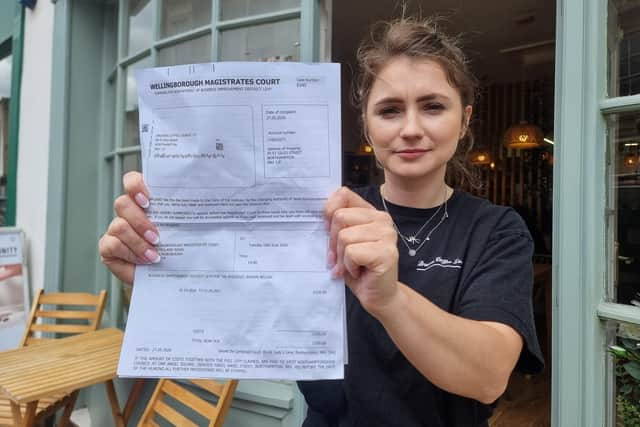
The figures come after this newspaper reported on Dreams Cafe owner Mariola Fuller, who appeared at Wellingborough Magistrates' Court on June 16 after choosing not to pay her annual £250 Northampton BID levy.
Mariola, who runs the St Giles Street cafe, said the levy was another cost putting pressure on her business. She also told us her cafe made a profit of just £67 in May and raised concerns about crime, anti-social behaviour and the state of Northampton town centre.

The Chron put in a Freedom of Information request to WNC requesting figures showing how many businesses have faced court action over unpaid BID bills, how much money was involved and how much has been recovered.
The figures show just how many businesses have ended up facing court action over the levy.
At the June 16 hearing attended by Mariola, around 200 businesses were sent court notices.
Around 120 were ordered by the court to pay what they owed, while 20 cases were withdrawn before the hearing.
The unpaid bills involved came to around £72,000, with businesses ordered to pay around £59,000 of that.
The Northampton Town Centre Business Improvement District (BID) is funded by a charge paid by businesses in the town centre. Its role is to help improve, promote and develop the town centre.
There were 1,151 businesses liable for the charge in 2021-22. That rose to 1,179 in 2022-23 and then fell to 1,134 in 2023-24. There were 973 in 2024-25, 993 in 2025-26 and 859 in 2026-27.
Despite the change in the number of businesses liable, the amount being billed has increased.
The BID billed around £286,000 in 2021-22, £285,000 in 2022-23, £304,000 in 2023-24, £308,000 in 2024-25, £314,000 in 2025-26 and £433,000 in 2026-27.
The amount collected was around £267,000 in 2021-22, £272,000 in 2022-23, £292,000 in 2023-24, £286,000 in 2024-25, £295,000 in 2025-26 and £323,000 in 2026-27.
Across the six years covered by the FOI, the number of businesses sent court notices was around 110 in 2021, 80 in 2022, 200 in 2023, 150 in 2024, 130 in 2025 and 210 so far this year.
The number ordered by a court to pay what they owed (liability order) was around 60 in 2021, 50 in 2022, 100 in 2023, 100 in 2024, 80 in 2025 and 130 so far in 2026.
Some cases were withdrawn before reaching a hearing. There were 30 withdrawals in 2021, 10 in 2022, 90 in 2023, 30 in 2024, 20 in 2025 and 20 so far this year.
The total unpaid BID bills being chased through the courts came to around £69,000 in 2021. That figure was around £33,000 in 2022, £106,000 in 2023, £71,000 in 2024, £76,000 in 2025 and £78,000 so far this year.
The amount businesses were ordered to pay was around £44,000 in 2021, £25,000 in 2022, £63,000 in 2023, £49,000 in 2024, £49,000 in 2025 and £63,000 so far this year.
The amount of BID debt recovered after court action was around £58,000 in 2021, £35,000 in 2022, £89,000 in 2023, £79,000 in 2024, £85,000 in 2025 and £68,000 so far this year.
Responding, Mark Mullen, chief operating officer of Northampton Town Centre BID, said: “The BID levy is a statutory charge and is a mandatory requirement for businesses that fall within the agreed levy criteria.
“The enforcement of the BID levy is not carried out by Northampton Town Centre BID. Billing, collection and enforcement of the levy are the responsibility of West Northamptonshire Council, as the Billing Authority, and are governed by the BID Regulations.
“The levy is calculated according to the rateable value of a business premises, based on the National Non Domestic Rates Listing. With the start of the new five-year term for the BID in April 2026, some businesses that were previously outside the levy criteria now fall within it, while others that previously paid the levy are no longer eligible. If there is any change in the overall businesses liable to pay, this should not, in itself, be interpreted as evidence of businesses closing.
“It is also important to recognise that the BID levy is a collective investment in Northampton town centre. Smaller businesses pay less than larger businesses because the levy is linked to rateable value.
“This collective approach creates the funding required to deliver the projects and services for the town as per the BID Proposal and Business Plan, and these activities are in addition to those services which are provided by the Council and Police as statutory authorities.
“Businesses that pay their levy on time are not being summoned for payment.
“We recognise that being summoned for late or non-payment can be a difficult situation for any business, particularly at a time when some may be finding trading conditions challenging.
“However, there is also a need for consistency and fairness. It would not be fair to those businesses who do pay, if others could simply choose not to pay without consequence."
At the time of Mrs Fuller's case, the BID said it had visited Dreams Cafe several times to discuss the support available.
It said businesses paying the levy receive a range of benefits, including marketing, promotions and tools for reporting anti-social behaviour.
WNC responded, saying: “The council cannot comment on the circumstances of individual businesses. Where payment is not received, we follow the agreed recovery process which includes reminders and, where necessary, court action.
“The council's role is to apply the BID levy collection and recovery process consistently. Summons figures reflect where payment has not been received by the required stage of the process. We continue to pursue outstanding accounts in line with our statutory responsibilities
“Court action forms part of the established recovery process and is used where reminders have not resulted in payment. The council has a duty to collect and applies the process consistently to all liable businesses.
“The council cannot comment on the circumstances of individual businesses.”