
Here's the latest on a delayed multi-million-pound refurbishment of historic Northampton town centre pub

Here’s the latest on the ongoing multi-million-pound refurbishment of a historic Northampton town centre pub as it nears a year of delays.
The Old Black Lion pub is undergoing a £3.5 million refurbishment after being purchased by Northampton Borough Council, later inherited by West Northants Council, and is now being restored by the Churches Conservation Trust (CCT).
As well as refurbished bars, a new restaurant, and sunny courtyard seating, the new facilities will provide a national base for the CCT and support more events in the neighbouring Grade I Listed St Peter’s Church.
The Old Black Lion, in Black Lion Hill, is set to become the “centrepiece” of the ‘Marefair Heritage Gateway,’ says the CCT, which will be home to hundreds of new flats, a new park, a hotel, and more.
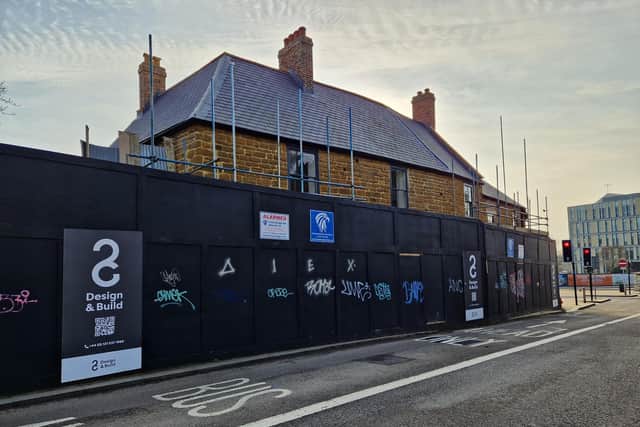

The council’s website says: “This project forms part of the transformation of the gateway into the town centre from the railway station. It will unlock the potential of the adjacent Grade I listed St Peter’s Church, allowing this area to become the beating heart of the Marefair community.”
Works started on site in March 2023 and were supposedly due to be completed in Spring 2024. However, a new completion and opening date was set for Spring 2025, which is fast approaching, and the pub is still not open.
The pub was featured on the BBC’s Digging for Britain, hosted by Professor Alice Roberts, in the New Year of 2024, which may have contributed to the delays.
A CCT spokeswoman said: “We are approaching the end of the capital phase of works at the Old Black Lion, with scaffolding due to be taken down this weekend. CCT is excited to be working with Phipps Brewery who will be on site next month to start the pub fit out and we look forward to welcoming customers to the pub very soon.”
WNC declined to respond.
Funding for the project includes £315,000 from the Towns Fund, £350,000 from S106 / CIL, £2,600,000 from the National Lottery Heritage Fund, and £100,000 from the Architectural Heritage Fund.