
Notebooks of Northampton-born DNA discoverer Francis Crick fetch £13,200 at Sworders auction
Diaries written by Northampton-born scientist Francis Crick, co-discoverer of the DNA double helix, have sold at auction for £13,200, offering a rare glimpse into the early career of one of Britain’s most celebrated molecular biologists.
The three volumes, penned between 1938 and 1939 while Crick was studying at University College London, formed part of Sworders’ Books and Maps timed auction, which closed on November 2. They were among a remarkable cache of manuscripts and letters by 12 Nobel Prize-winning scientists.
Crick’s neatly written journals record his daily laboratory work and references to his technician, Leonard Walden, throughout. Two volumes are inscribed “FH Compton Crick, U.C. London, Physics Research Lab.” His doctoral research at the time focused on the viscosity of water at high temperatures - a far cry from the genetic breakthroughs that would later define his career.
The war interrupted Crick’s studies, and he went on to serve as a scientist for the Admiralty Research Laboratory. It was during his later work at the Cavendish Laboratory in Cambridge that he met James Watson, with whom he famously identified the structure of DNA. Their discovery, published in Nature in 1953, earned Crick, Watson and Maurice Wilkins the 1962 Nobel Prize in Physiology or Medicine.
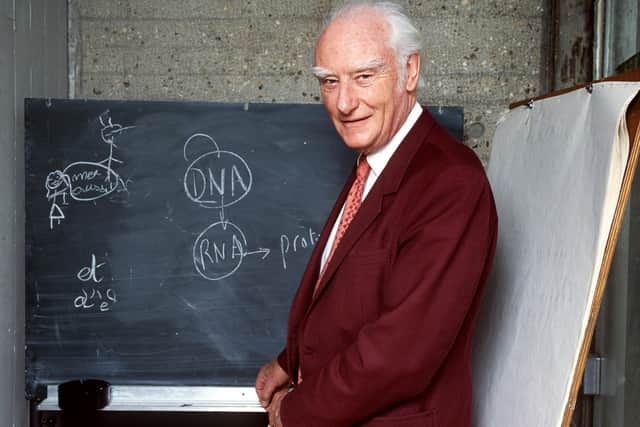

The diaries were accompanied by a 26-page typed report to the Department of Science and Industrial Research, annotated and corrected by Crick himself. Estimated at just £800 to £1,200, the lot sparked strong competition before reaching its final hammer price.
Also featured in the sale was a copy of Crick’s 1962 Nobel Lecture, inscribed and signed: “For Leonard Walden who knew me first before it all happened, Francis.” The lot, which included four autographed letters, had been expected to fetch £500 to £800 but soared to £10,200.
Leonard Walden, who received the George Medal and Bar for his wartime work on mines and booby traps, worked as a laboratory technician in London for several leading scientists. The papers were originally left to his eldest daughter, who stored them in a suitcase in the loft before they were rediscovered and brought to Sworders for valuation.
Sworders’ rare books and manuscripts consultant Michael Kousah described the collection as “a very important find”.
Among the manuscripts were letters from some of the 20th century’s greatest scientific minds, including Niels Bohr, Ernest Rutherford, Sir William Lawrence Bragg, Sir Edward Appleton, and Dorothy Hodgkin.
Six letters signed by Niels Bohr sold for £5,000, with the Danish physicist writing warmly of Rutherford - “He showed, however, himself a kind sympathy for my youthful enthusiasm and became till the very end of his life almost a second father to me.”