
Northampton General Hospital consultant who approved Luke Abrahams’ surgery apologises for not speaking to family before his death

The Northampton General Hospital consultant who approved Luke Abrahams’ operation before his tragic death has apologised for not speaking to his family beforehand.
The inquest into the death of Luke Abrahams continued on Tuesday, almost three years after he died.
Luke, from East Hunsbury, died at Northampton General Hospital on January 23, 2023, after first complaining of a sore throat a week before his death, which later led to sepsis and then necrotising fasciitis – a rare but life-threatening infection often described as a “flesh-eating disease”.
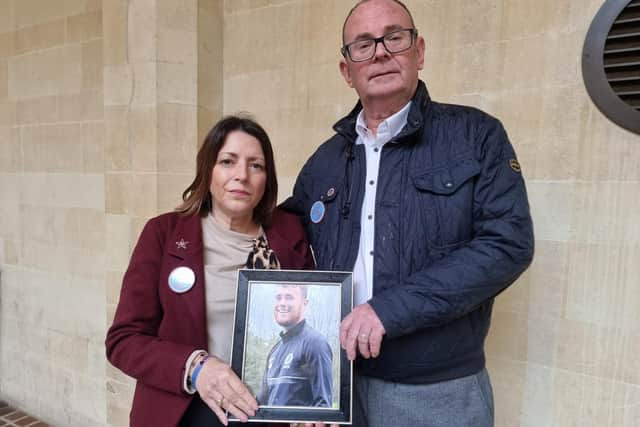
His death was initially recorded as natural causes and no inquest was opened. However, his parents, Richard Abrahams and Julie Needham, pushed for a formal investigation with the support of Hudgell Solicitors. The inquest was later confirmed by Anne Pember, Senior Coroner for Northamptonshire.

Giving evidence, Ms Claire Brown, a consultant surgeon at Northampton General Hospital, told the inquest Luke’s infection was not survivable by the time she assessed him and that surgery was his only chance of survival.
“I believed it was not survivable before I took him to theatre,” she said. “He was already in septic shock. Surgery was his only chance of survival.”
Ms Brown, who covers emergency surgical cases overnight, said necrotising fasciitis can spread rapidly and often requires input from multiple specialist teams.
Luke was booked for surgery at 1.16am, and Ms Brown assessed him at 1.32am, within 30 minutes of being contacted.
She said Luke was already in septic shock, with low blood pressure and a fast heart rate, describing his case as very unusual.
The inquest heard Luke’s leg had no pulse and had become cold, requiring amputation to remove dead tissue. Ms Brown said she believed Luke was unstable throughout.
“Although surgery was designed to make him better, it would have contributed to further instability – but it was necessary,” she said.
Under questioning from Ms Leila Benyounes, counsel for the family, Ms Brown said necrotising fasciitis is easily missed, particularly in young, fit patients, and told the court that around half of cases are initially misdiagnosed.
She said without surgery Luke’s death would have been inevitable. “If he hadn’t been operated on, he would have died and that was inevitable,” she said.
Ms Brown also spoke emotionally about her interaction with Luke just before surgery.
“When I discussed surgery with Luke at the time, he was amazing – incredibly brave,” she said. “He was alert and orientated, and when I spoke to him he was able to converse with me very well. He was just really brave and lovely. I spoke to my operating department practitioner about him the other day and he said Luke had been laughing and joking with him.”
Looking at the family, she added: “I really did care, and I do care.”
Ms Brown said she would have liked to have known about Luke earlier, adding that the case had since been discussed internally to reinforce escalation of suspected necrotising fasciitis.
She ended her evidence by apologising to Luke’s family for not speaking to them sooner.
“I would have liked to have sat down and spoken to them. It is my usual practice to talk to families beforehand. Why I didn’t on this occasion, I can only say I was incredibly focused on getting him into theatre. I’m incredibly sorry I didn’t. I was trying to get him into theatre as soon as possible.”
Ms Brown ended her evidence by repeating her apology.
“I am sorry I didn’t phone you,” she said.
Luke died later that morning.
The inquest continues.