
Family of soldier in Northamptonshire army regiment attend service as grave finally identified after 80 years
The graves of two soldiers who were part of the 1st Northamptonshire Yeomanry have been identified after the family’s 80-year search for closure.
Trooper Francis Dominic Kelly and Trooper Victor Terrence Little of the Northamptonshire regiment were killed during the Battle of Normandy in August 1944, and were later laid to rest in the Banneville-la-Campagne War Cemetery in France.
After their graves were identified, on June 26 rededication services took place whereby the family of Terrance Little were able to pay their respects.
There, Trooper Little’s nephew, David Little said: “We were so wonderfully surprised when Joint Casualty and Compassionate Centre (JCCC) contacted us regarding our Uncle Vic as there has always been a sadness that Victor’s remains had never been found.
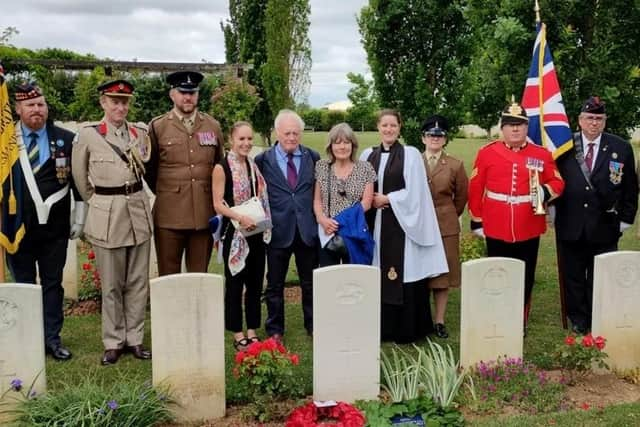

"We’ll always be grateful for the work of the JCCC War Detectives in enabling us to attend the rededication service of dear Victor on behalf of his parents and siblings.”
The grave of Private John Aneurin Protheroe of 2nd Battalion The Monmouthshire Regiment, was also identified.
A researcher submitted cases to the Commonwealth War Graves Commission (CWGC) with possible locations for each of their graves and, following further investigation by CWGC, the National Army Museum and the Joint Casualty and Compassionate Centre, the identities of the soldiers were confirmed.
Rosie Barron, JCCC Caseworker, said: “It has been a pleasure to work with the military party to organise these services and to have had the families of Trooper Little and Private Protheroe present. It is important that the memory of these men is honoured, and a strong reminder that the fighting in Normandy did not end on D-Day, but that the Battle of Normandy lasted until the end of August 1944 and was hard won by the Allies.
All three men had previously been commemorated on the Bayeux Memorial to the missing.
The previously-unmarked graves have since been replaced by headstones bearing each of the soldiers' names.
Fergus Read, Commemorations Case Officer at the CWGC, added: “It is an honour to have been involved in the research that led to the formal identification of these men.
"It is a privilege to play a part in establishing where these casualties of the battles in Normandy are buried.”