
The John Griff column: When flawed health can be inspiring
The title of this piece might itself be slightly flawed. ‘Flawed health’ indicates variance from usual parameters of ‘normality’, or outside of what might otherwise be expected in someone. Medical science rarely delivers a miracle – they’re usually in the gift of a higher authority.
I had wanted to speak to the man not as an Olympian, a medallist or even as a cyclist. Hoy had by then embarked on a new form of competition - one rather more rapid than that which had made him a household name on two, very thin wheels. I found him in one of what was then Rockingham Motor Speedway’s pit garages as racing driver he had signed on to be. Immensely experienced in the saddle, he was a comparative rookie here.
If I had imagined that he would be a little puffed up from the recognition of his world-beating achievements (and I think I had) then I was to be proved wrong. Towering above me as he did and broad in shoulder and chest, I found Chris Hoy to be anything but the intimidating champion I had mentally painted him to be. Instead, he was the same humble-speaking, humble-acting person who had charmed millions of armchair TV viewers (and experts too) around the world.
Our conversation had not been pre-arranged. In such circumstances, things usually go in one of two ways. A guest (more of a target really) can say ‘yes’, or ‘no’ to an interview there and then. If it’s a positive response you get cracking as soon as you can. Alternatively, a guest can refer you to a third party to green light the interview - or not. In this instance I waited until Chris had finished speaking to his engineer before approaching.
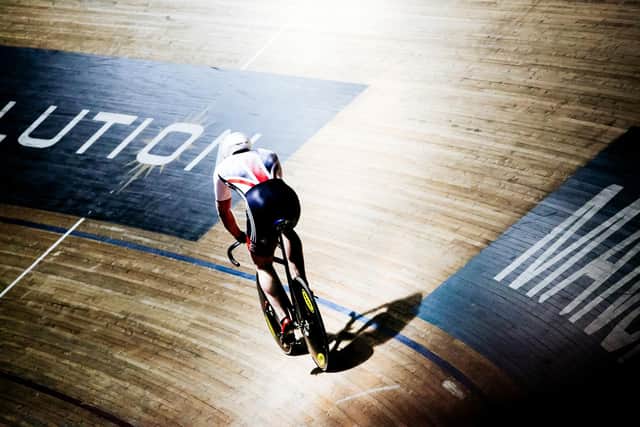

Having presented my credentials and said what I wanted to do, he replied that he was happy to speak to me - but that he would go and seek the racing team’s head of media to clear it ‘just to make sure it’s ok…’ . I’d had this happen before, only to find the interview denied. Now, after a few minutes of waiting, I was ready to head back to the car park. Suddenly, Chris Hoy re-appeared and with a big grin, apologised for keeping me and asked what I wanted to know. Whereupon began about fifteen minutes of conversation with as warm a human being as I have ever had the pleasure to speak with. It wouldn’t be the last time we spoke, either. Years later and before the 2020 Tokyo Olympics I interviewed him ‘down the line’ – him in a studio in London and me in a studio here in Northampton.
Unseen, he was as affable then as he had been in person, talking about his family, punditry and lots more. By the time we finished I’d have walked over hot coals for him – he has an engaging way with people which is simultaneously disarming and encouraging.
It’s why Sir Chris Hoy’s news last week felt like a personal loss.
Released through Sunday’s press, we learned that his cancer is, sadly, terminal. Given between 2 and 4 years of life expectancy, the content of the announcement was as carefully managed as it was unremitting in its language.
Astonishingly perhaps, he said that he felt strong, fit, healthy and ‘lucky’ despite prostate cancer moving to attack his bones. Gently, he explained what he had already known for a year. It felt like he had been protecting the nation, but that the time had come for straight talking. That his wife Sarra has MS makes the situation for Chris’ wider family all the harder – maybe more so still through the outpouring of genuine affection, support and concern which followed immediately afterwards.
Now, his lead is being followed by others. This week the BBC published a piece highlighting the symptoms of prostate cancer. I read it and did so for me. A dialogue is opening about the subject – as it should, because too many ignore the signs and symptoms. His attitude is already inspiring people to enquire and act if they think something is wrong. In his remaining time Sir Chris Hoy’s example could prove to be lifesaving. The tragedy will be that it cannot save his own.
Again, he is a champion. And again, a giant.