
The John Griff column: When celebrity means what it says…

Some time ago I asked the question ‘Whose lives should we genuinely celebrate?’ When considering the Cult of Celebrity which seems to be omnipresent, if not in terms of actual performance or talent in some sphere, is the ability of someone to promote or otherwise impose themselves upon the consciousness of the wider public a sufficiently good qualification for the achievement of that status?
Having presence in the wider consciousness is one thing – but what a person actually does with it is, I suggest, something very different. To be a contestant on TV’s Love Island does not, in itself make that contestant a celebrity, however the tv company or contestant’s agency might want to spin it. No. celebrity, or being celebrated – has to be earned through activity – and positive activity at that. All of this was evident in the announcement and validity of the 8 individuals celebrated by being the subjects of new Blue Plaques unveiled in their honour by West Northamptonshire Council a couple of weeks ago.
Each individual had made their own substantial and very positive contributions to the wider community during their lifetime. ‘Had’ is an operative word, because all 8 have been gone for over twenty years. It was one of the criteria for a judging committee which evaluated nominations over sixty separate individuals submitted by members of the public some months ago. Plaques for the chosen 8 have now joined 4 others installed in 2021, completing a dozen. Funded by Arts Council England under its ethos of ‘Let’s Create’, they can be found in a variety of locations from the county town to the countryside.
78 Derngate, the revered Charles Rennie Mackintosh-designed former home of model engineer and businessman W J Bassett-Lowke has one of the new plaques next to its front door. A detail and design devotee, Bassett-Lowke served in local government here, helped develop The Mounts Baths and adjacent fire station, as well as in 1926 being one of the founder-members of the Northampton Repertory Theatre. His is a legacy which endures to this day, even though he himself died in 1953.
Legacy is similarly commemorated at the front entrance to the Barratt Maternity Home at the nearby General Hospital. Without the generosity of industrial scale shoemaker William Barratt, the eponymous building (where I, as did countless others, made my own first entrance just over sixty years ago this week) might never have existed. It arrived thirty years before I did following Barratt’s monetary gift of £20,000 – a fortune at around £1.5 million in today’s monetary equivalent. Mark the word – his was a gift to the people of the county.
But blue plaques don’t come about only through largesse. The latest crop includes Alfred Cockerill who helped to establish and then secure the future of Northamptonshire County Cricket Club, the building of Christ Church, Abington Avenue Sports Ground, and more. Founder of the Pioneer Co-Operative Boot works, James Gribble, raised money for the Social Democratic Federation. In 1905 he became its President and organised the Raunds March, which protested in London over workers right during grinding hardship in the boot and shoe industry. Conducted on neo-military lines, Gribble earned the nickname ‘General’ and although thrown out of the Palace of Westminster for disrupting Parliament, he raised the profile of the issue and not only in boot and shoe.
There are others. Engineer Joseph Grose fundamentally shaped and strengthened the town’s transport and industrial reputation. Joseph Gurney the Mayor of Northampton who backed the reform Acts of 1832, 1867, and 1884 and supported fellow politician Charles Bradlaugh. Harriett Nicholls, who, in 1947 became the town’s first ever Mayor. And Rose Scott – Northampton’s first female councillor who campaigned for adult suffrage and against poverty.
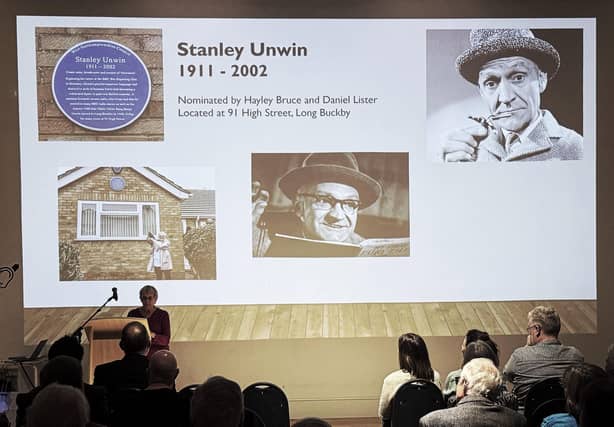
There are others celebrated with blue plaque in their name and hence having celebrity conferred on them. But there’s one I’d have really liked to meet. His plaque is fixed to the wall of an unassuming bungalow in Long Buckby which was home to a former wartime BBC morse code operator and engineer. He unexpectedly went on to entertain and delight millions with his spontaneous wrangling of the English language – we now call it ‘Unwinese’. A gentle man in the truest sense, Stanley Unwin became - rightly - a national celebrity. Stanley’s daughter Lois told me that her father’s response to ‘being plaqued’ would have been:
‘Fluttery of the heart strings – a lump in the throacus – and deep joy all round.’
I couldn’t agree more.