
The John Griff Column: A modern day wonder?
They’ve been globally recognised for a long time, but if we were to take a blank sheet view, what would today’s technological 7 Wonders of The Modern World be?
Would the list include cloud skimming pieces of architecture, rockets and spacecraft destined for Mars and beyond, perhaps the mysterious and intangible AI? Or might the list include rather more mundane yet indispensable items?
It is perhaps our pre-disposition to imagine superlatives when trying to narrow down to just 7 the breadth of marvels which most people now access in their daily lives without a moment’s thought. Technology has accelerated at such a pace since World War 2 that we now live lives that might otherwise have only been suggested by TV’s forward-looking ‘Tomorrow’s World’ just a few decades ago. In my lifetime I have seen the emergence of the digital age with computers getting smaller and faster, the invention of laser light and machinery, man landing on the Moon (in part thanks to WW2 innovation), nuclear energy for power, solar power, battery power and so much more. The worldwide web came about in 1989 when CERN-based British computer scientist Tim Berners-Lee created it so that fellow scientists and researchers could keep in touch more efficiently. In an altogether different but not unrelated field, mobile telephony is now so commonplace that we take it completely for granted. And not just telephony either – today’s smartphones are far more than instruments for verbal communication between individuals. I use my mobile phone for information via the internet far more than I do for actual conversation – I suspect that I am part of the vast majority who do similarly.
But perhaps I have romped through global innovation rather too quickly and at too lofty a level. Perhaps it would be better to start the list rather more humbly – and in what may develop into an occasional series here, I’d like to suggest something which can be found in almost if not every car, aircraft, spacecraft, home and place of work, computer, garden shed and hospital. Few inventions have evolved around the simplicity and utility of the humble cable tie. Universally taken for granted, the cable tie holds some things together, holds others apart, supports things, prevents things from getting tangled up and so much more. It truly plays a fundamental role in our everyday lives and work – and is invaluable as a result. Minimal in its design, it is a brilliant, minimalist example of something we can all find uses for to the extent that it becomes an essential.
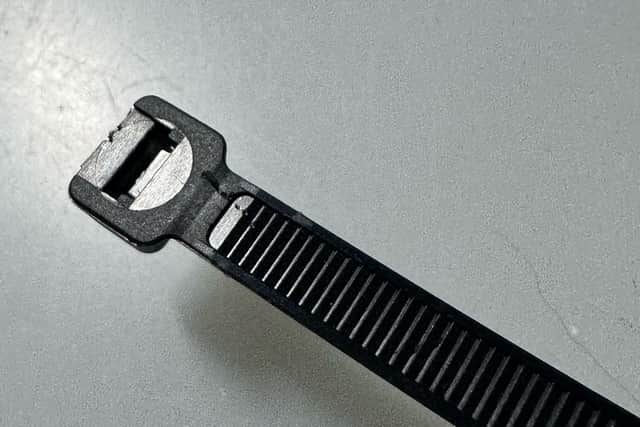

Invented in 1958 by Maurus C. Logan, the cable tie was originally known as a ‘Ty-Rap’, designed to manage the intricacies of aircraft wiring. At first glance, the cable tie seems very simple - a single strip of nylon in any colour and size with a ratcheting mechanism at one end and a pointed end to be inserted into the ratchet at the other. The ratchet allows the tie to be tightened to any diameter, securely fastening objects of varying sizes. As it tightens, the tie locks in place, ensuring a firm hold. The tail can be trimmed with a pair of scissors or clippers and if necessary, multiple cable ties can be linked together in a kind of daisy-chain to accommodate the largest of tasks. Some cable ties are made to be loosened again, making them reusable or their task scaleable.
Cable ties are generally made from nylon, being strong, flexible and resistant to wear and tear. In certain applications (such as road signs or on telegraph poles) they are made from stainless steel cable where they are better suited to variations in temperature or corrosion. UV-resistant ties are often used in outdoor settings where exposure to sunlight would degrade ordinary nylon.
I usually keep cable ties in my gadget bag of recording equipment. I use them to make installations safe, keep trailing cables out of the way of unwary feet and fingers, or to keep my workspace (which is often highly temporary) clutter free. I use them in DIY projects at home for the same reason – our security lights would not shine out onto our yard as they do without cable ties.
When you next use one – and you will, I’m sure, consider the simplicity of cable ties, how they work and the intricacy of their design. They are, I suggest, modern marvels and worthy candidates for being considered a Wonder of the Modern World.
One down – what’s number 2?