
The Father Oliver Coss: Northampton 350 - Recovery, Reconciliation, Regeneration
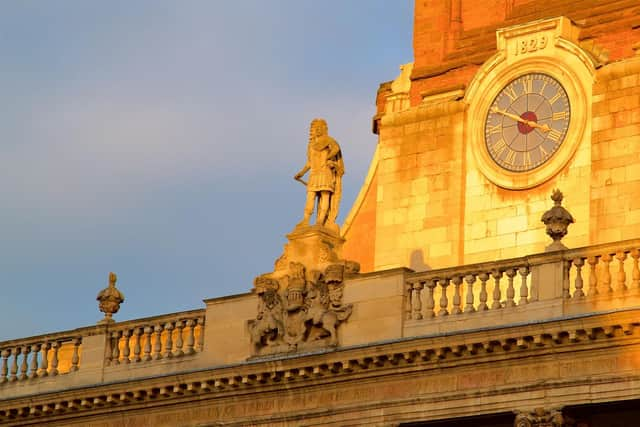
Years ago the statue of King Charles II which proudly stands atop the portico of All Saints’ Church was complemented by similarly imposing statue of the former Prime Minister Spencer Perceval.
The latter was a Northamptonian Prime Minister, who has the sorry distinction of being the only one to be assassinated. A parity seemed to exist between Charles, during whose reign the slave trade had been initiated, and Perceval who was noted for completing the passage of the abolition legislation through Parliament.
These days Perceval’s statue stands in the Guildhall, but the reasons for Charles II’s commemoration in Northampton are no less significant than when Mayor John Agutter erected the statue in 1712. It was a solemn remembrance not merely of Charles II’s restoration as King of England, Ireland and Scotland, but of the turning of his heart in the aftermath of the Great Fire of Northampton. In 1662, thirteen years before the fire, King Charles had sent his Lord-Lieutenant and Deputies to destroy what remained of the castle and the town walls, as he sought to avenge the prosecution of the Civil War and the death of his father Charles I. Northampton, as noted Parliamentarian town, came under the spotlight and was duly punished.
On the 20 September 1675, this devastation doubtless had an effect on the rapid spread of the fire through the town’s timber and thatch housing stock, but so too did the town’s industriousness. It had been a very good harvest that year, and the town was stacked with fuel laid up for the winter ahead. It’s remarkable that there were only eleven deaths, amid the hundreds of families displaced and dispossessed.

In London, after their Great Fire, it had taken eighteen months to pass a bill for the reconstruction through Parliament. If anything was going to happen in Northampton they needed the King’s support, and it was through the intercession of James Compton, the Third Earl of Northampton, that reconciliation between the town and the Crown was effected. Charles II would become the principal benefactor of the reconstruction appeal, and so immense was the generosity of the country at large to the town that it only took two months to get things moving.
The speed and the quality of what replaced it continues to constitute our famous town centre, albeit surrounded by other more modern evolutions in our townscape. It is a cogent reminder that there is no crisis so deep in our civic, economic, or cultural life that we cannot recover, renew, and regenerate. First, however, we have to come together.
At such a time when communities are divided by fear and mistrust, aided by those always eager to exploit those things, we have a chance to come together as we mark 350 year since the Great Fire of Northampton and see that if we do not yet have the town we want in our own day, it is because we have not yet begun to work for it.
These commemorations (and five months of special events ahead of us) begin on Oak Apple Day, 29th May 2025, with a Service of Thanksgiving at All Saints that begins at 11am. Come early before all the good seats are gone!