
Thailand prioritises equal rights in bid to host WorldPride 2030

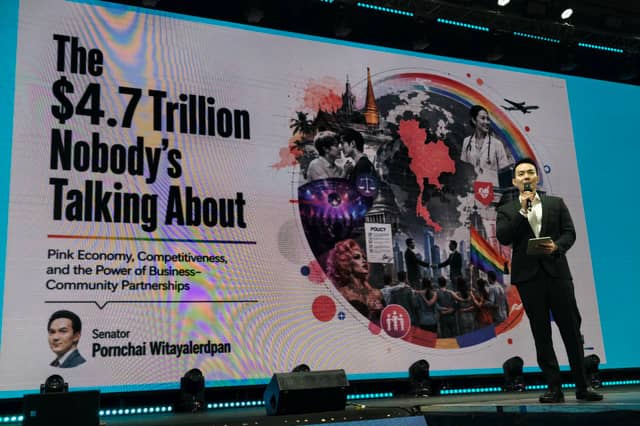

The Pink Economy report highlights Thailand's commitment to equal rights as it bids to host WorldPride 2030 in Bangkok, a major milestone for the country's LGBTQ+ community.
A new report from Thailand's Senate has called for stronger LGBTQIA+ rights and protections, arguing that equality must form the foundation of the country's growing "Pink Economy" as Bangkok pursues its bid to host WorldPride 2030. Produced by the Working Group on Advancing the Pink Economy Strategy and Preparing for WorldPride 2030, under the Senate Standing Committee on Foreign Affairs, the report examines 15 industries linked to LGBTQIA+ communities, including television, publishing, beauty services and gender-affirming healthcare.
The report argues that while these sectors make a significant economic contribution, growth should not come at the expense of human rights and inclusion.
Senator Pornchai Witayalerdpan, chair of the working group, said: "Equality is only complete once people feel it in everyday life – at work, at the clinic, in public services. When everyone is recognized and protected, the economy grows fairer and its opportunities reach far more people."
Drawing on research from the World Bank and academic studies, the report concludes that discrimination and stigma continue to create economic costs through lost productivity, poorer mental health outcomes and employment insecurity. The central argument is that stronger rights and protections help build trust, which in turn attracts investment, creates jobs and generates economic value. That value can then be reinvested into welfare, worker protections and further equality measures.
The report recommends incorporating Pink Economy policies into Thailand's next national development plan, identifying Bangkok, Pattaya, Phuket and Chiang Mai as potential pilot cities.
Among its recommendations are the introduction of legal gender recognition, gender-neutral nationality rules for Thai-foreign couples and measures to ensure marriage equality translates into equal access to loans, property ownership and public services. It also highlights concerns around healthcare access, arguing that gender-affirming care should be available to Thai citizens as well as international visitors seeking treatment in the country.
The report further draws attention to employment conditions across industries where LGBTQIA+ people are heavily represented, including entertainment, beauty and creative sectors. It calls for fair contracts, social security protections and appropriate pay for workers including drag performers, writers, make-up artists and film production crews. For creators working in the increasingly popular Boys' Love and Girls' Love genres, the report advocates stronger intellectual property protections and opportunities for ongoing royalty income.
To help prevent so-called "rainbow washing", the report proposes a voluntary certification system for businesses promoting themselves as LGBTQIA+-friendly, alongside external oversight involving consumers, academics and civil society groups.
The findings position WorldPride 2030 as a catalyst for long-term reform, with the report proposing six lasting policy legacies spanning legal rights, city infrastructure, healthcare access and employment standards. According to the report, success should ultimately be measured by whether Thailand delivers stronger laws, safer cities and better protections for LGBTQIA+ people, rather than solely by attendance figures at a future WorldPride event.
The recommendations complement wider commitments outlined within Bangkok Pride's WorldPride 2030 bid, including the proposed Bangkok Action 2030, which seeks to promote legal recognition and health equity across the region.
Ann Chumaporn, Core Team Lead of WorldPride 2030, Bangkok Candidate City, said: "Everyone has to be able to earn a living with dignity and security without hiding who they are. These rights need to be secured and protected for the generations that follow. Until that is true for everyone, our work is not done."