
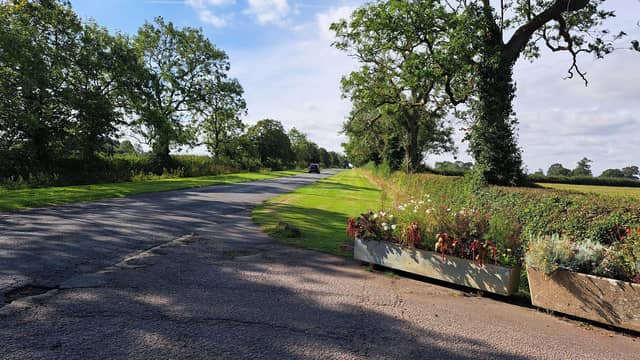

There is a road that links the village of Denton north bound to Horton that has extremely wide verges, which are still maintained to this day. These verges are adjacent to the now long disused Yardley Chase Ordnance Depot. This depot was also known as a Forward Ammunition Depot (FAD), where munitions were distributed ready for use by the Armed Forces. The wide verges were constructed to park large numbers of what we would now call today, Rigid HGV Trucks parked side by side on the Denton to Horton Road ready to be loaded at the Forward Ammunition Depot.
Convoys of the loaded trucks would be accumulated on concrete hard standings in the cover of Salcey Forest before running down in convoy to the invasion ports for loading ready for the Normandy Invasion. Although lifted and long gone as a result of the Railway closures in the 1960s ,on the Northampton to Bedford Railway line is Piddington Station where the rail link into the Yardley Chase FAD had its junction. But it is interesting to note that the village of Piddington is actually 4 miles away to the west.
Quite clearly this was part of the wartime disinformation around military buildings and depots. Today as can be seen the wide verges are in some cases well cared for. The Forward Ammunition Depot is long closed, but the Army Cadet Force have taken over the site with a modern accommodation block. My sons when they were part of the local Army Cadet Force would exercise all over the site.
To the north of the County is Harrington Airfield which in itself played a small, but vital part in the invasion of Europe. There were many air bases across the county as is well known. From training bases, such as Sywell , Denton, and Silverstone, to the US Army Air Force, bases of Chelveston, Kings Cliffe, and Polebrook. Harrington airfield was built by US Army Engineering Battalions starting in early 1943 and was intended as a satellite airfield to RAF Desborough training base 6 miles to the north.
The RAF base was opened by a small group of RAF personnel in September 1943. Harrington was only fully completed early 1944. It was clear that the Base was destined for bigger things when the handover ceremony to the USAAF was attended by General Ira Eaker of the US Army Air force, and Air Vice Marshal Bomber Harris of the Royal Air force.
Harrington was the base for the USAAF 801st. Bombardment Group that became known as the Carpetbaggers. Originally the Group was equipped B24 Liberators which were unusual in that they were specially modified and painted black for night operations only. The intention for Harrington was that it was to become the start off point for Special Operations flights into the European mainland This was to augment the original Special Operations Executive, flying operations base at RAF Tempsford in Huntingdonshire. Harrington was to be the launch point for the Jedburgh Teams. This was to be a joint Special Operations Executive S.O.E. and Office of Strategic Services O.S.S. operations.
The Jedburgh Teams or Jeds as they came to be known were to be dropped by parachute behind enemy lines into Northern Europe. But at first, particularly France, operating behind enemy lines to aid and organise the local resistance groups in preparation for Operation Overlord, the Normandy Landings. Not only the Jedburgh Teams were parachuted into France , together with, Other Agents, Arms and Ammunition and their most powerful asset.
The Jed B2 radios. The teams were to play an important part in organising guerrilla action throughout the Invasion disrupting communication and generally disrupting the German troop movements , keeping many troops away from the Normandy Battlefield. As the war progressed to its later stages the Jedburgh Teams were used in Holland and Belgium . The teams were also used in Southeast Asia Command SEAC, both in Burma, what is now Vietnam. ( Indo China ), and the Malay Peninsula
Not only did the Carpetbagger Squadrons convey Military OSS Agents into the Western Europe theatre of operation they conducted both leafleting and newspaper dropping raids Also some secret, covert reconnaissance, and observation, missions.
The missions continued until August 1945, whereupon the Group was reformed as a Very Heavy Bomb group at Sioux Falls South Dakota USA.
For fuller information and absorb the atmosphere of the Base A visit to the Carpetbaggers Aviation Museum Harrington NN6 9PF is recommended.
Today the view from the Lamport road (A6 access) to the A14 by road show only cereals fields with some rather odd growths of bushes and brambles in the middle of wheat and barley fields These growths actually surround the 3 RAF launch sites for Douglas Thor Intermediate Range Ballistic Missiles, these were deployed in 1958 for about 3 years, before being quickly deactivated. They can still be seen from the Air As a result of USAAF operations during World War II, a Memorial as a Fitting Tribute to the personnel that did not come home. It has been erected on the Lamport Road. From the map of the airfield, it is halfway along the short straight beside the airfield on the right-hand side.
Little is known about the uses of Brockhall Hall during the Second World War, like many large Country Houses in Britain at the time of War it was taken over by the Government / Military for various purposes. Being discreetly situated beside the A5, it certainly was used by SOE as a final finishing school for SOE Agents. It was taken over by the OSS in early 1944 as their finishing school for agents and Jed teams destined to become part of the Normandy Invasion and later into Northern Europe.
Where does the Sunnyside Public House on Boughton Green Road in Northampton fit into this picture . Because of its then secluded location and being adjacent to both Brockhall Hall, and Harrington Air base. It was used a holding location, and accommodation, for the special agents prior to their parachute operations into mainland Europe.
Another airfield that holds a place in the wartime history of Northamptonshire is Spanhoe , near Laxton, in the very northeast of the County. Originally constructed by US Army Engineers and opened as RAF Spanhoe in late 1943, finally completed and occupied by the USAAF in February 1944. By the 315th Troop Carrier Group this was in anticipation of the coming D-Day.
Like many airfields constructed at the time it was part of the logistics planning for the 6th of June D-Day Landings invasion of Europe.
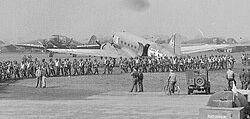
Figure 5 Training takes place with a background of C47s.
Training took place right up until June 1944 when the group were part of the Parachute Landings for D-Day in France.
The 101st and 82nd were both involved in the D-Day parachute landings. As is recorded quite accurately in the Film the “Longest Day” with John Wayne playing L/Col Benjamin of 505th US Parachute Regiment The next operation that the 315th Troop Carrier group undertook was a major part in Operation Market Garden. Where 82nd and 101st Airbourne Divisions were involved in the taking and holding the bridges at Son ( Eindhoven) and Grave ( Nijmegen). The Polish Parachute Regiment were also transported from Spanhoe, for the Battle. The crossing of the Rhine, “ Operation Varsity” at the latter stages of the War was the last major action that the Group took part in. Although by then the group was based in France. In May 1945 the 315th Troop Carrier Group, by then had moved on. There is a memorial, to those aircrew that did not return from operations It is on the approach road to the very few remaining buildings on the site.
Spanhoe on the wind down after theGerman Surrender began to take on a more benign mode of operation in that it became in 1946 the site for the disposal of surplus military equipment . There is a photograph showing long lines of Army Trucks, Specialist Vehicles, and Jeeps, etc, all waiting to go under the hammer. The vast majority of the land reverted to agricultural use. A small part of the northwestern Edge of the airfield was excavated as part of the Harringworth opencast Mining operation for Iron Ore. There was also a Private Grass Runway operated for some years. But today all is now peaceful and green on the Spanhoe Airfield.
Another site which bears the unmistaken able stamp of War Time is the Packaging Factory on the corner of Kettering Road and Moulton Way Northampton This was the former site of Brooklands Aviation at Buttocks Booth. Brooklands Aviation had established a Major Base on Sywell Airfield for Elementary Flying Training and instruction -- EFT schools. With the coming of the Second World War a manufacturing and repair facility for Heavy Bombers and later the construction of the Lancaster Bombers was opened at Sywell. As part of the Shadow Factory scheme, a second Major Unit with hanger sized buildings and maintenance units on the site, was opened in 1940 at Buttocks Booth, or as it is known today as Lumbertubs. The site at Buttocks Booth was mainly involved in the repair and maintenance of Wellington bombers. During the War there some 2000 people employed in the maintenance work, giving well paid employment to Northamptonshire people. Because the Wellington Bomber was fabric covered, Women were employed in the recovering, stitching and painting the recovered bodies with Cellulose Lacquer. This would stiffen and harden the Fabric , strengthening, being much lighter than aluminium panels and cheaper. The people engaged in this work were known as “ Dope Judie’s” There were out-working Workshops, producing parts and assemblies for the main factory. This sort of manufacturing and assembly draws a direct comparison to the Boot and Shoe industry in using the same Manufacturing Model. There was subcontracting workshops established in Northampton. The Corporation Bus Depot, also in the ESSO garage at the bottom of Kingsley Park parade. Now long demolished and rebuilt as a Car Repair and MOT centre. As can be imagined transporting the damaged Bombers coming from outside Northampton and moving these different parts and assemblies to the 2 Brooklands factory sites was a major undertaking. This was done with Bedford Queen Mary Low Loaders with latticed sides and could take wing sections, or a whole Wellington Bomber bodies to the assembly points. This is about the same length as a modern HGV Class 1 Unit and a 40-foot trailer .
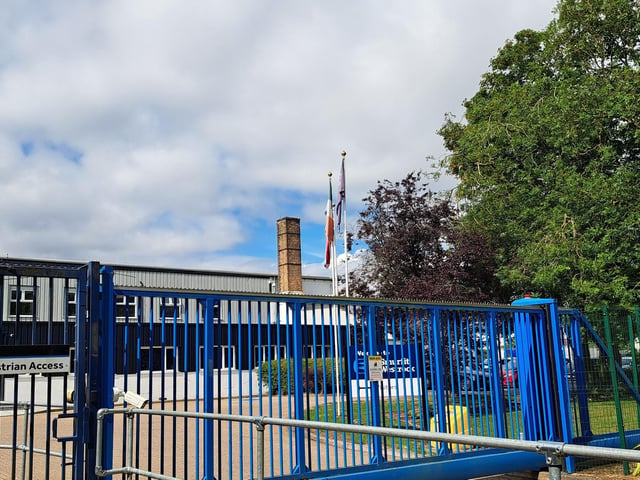
The Main factory today looks very different today from the war and post war years under BrooklandsAviation. Modern materials and the re-construction of the original hangers and buildings to modern standards by the present owner, Smurfit Westrock. But the only piece of the original buildings is the Chimney Stack to the boiler room in the middle of the photograph which is still in the original WWII utility Brickwork. and demonstrates the wartime economic construction methods.
There are numerous other sites and buildings around the County and the former Soke of Peterborough that can be identified as World War Two sites, which tucked away, converted, or brought back to agricultural use. Refurbished to modern standards with small hints of their former use. Or even RAF Silverstone, 1943 the home of 17 Operational Training Unit operating Wellington Bombers, to becoming the famous Motor Racing Circuit in the United Kingdom.
All of these sites, buildings, and memories add to the rich historical legacy of our county. It is only by observing your County will you be able to see these historic Sites and Buildings
Sources:-
Railways of Northamptonshire, David Blagrove.
Northampton Chronicle and Echo
6. Contributed
The Front entrance to Smurfit Westrock premises formerlythe Brooklands Aviation plant Buttocks Booth Photo: Submitted