
My Mother’s Funeral: The Show Review
Abigail's struggle for artistic integrity in a world of commercial narratives An intriguing new play written by Kelly Jones and produced by Paines Plough, tells the story of struggling playwright Abigail, (Nicole Sawyer) whose journey to reclaim her story takes centre stage.
Framed by the recent death of her mother, this raw, thought-provoking piece directed by Charlotte Bennett, examines the clash between personal narratives and the pressures of commercialisation, all through Abigail's conflicted lens.
“This story is told through my lens,” Abigail declares, determined to shape her own truth.
“That’s not the lens we are after,” smug pompous theatre director (Samuel Armfield) is more interested in stories that will sell rather than in authenticity.
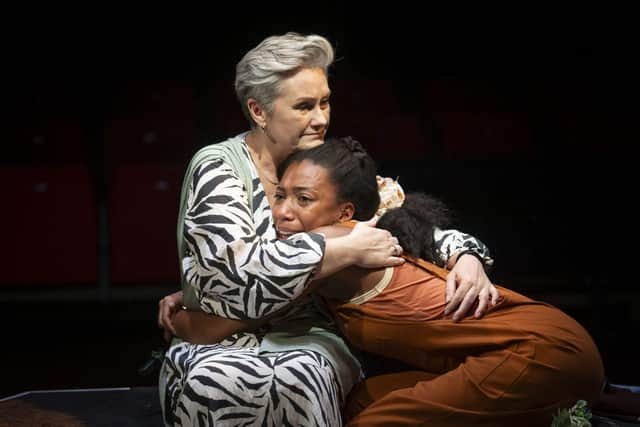

The play deftly criticises the exploitation of pain, trauma, and working-class motifs by a hungry theatre industry eager to appeal to mainstream audiences.
Abigail’s desperation to pay for her mother’s funeral that she can’t afford, fuels the drama.
Determined to pay for a private funeral as opposed to a council funeral, she is driven to write a play telling her own story growing up in a council flat in Dagenham.
Nicole plays an Abigail that is desperate to honour her mother through sacrificing her art.
With each draft of her script, we watch as she compromises her vision, inching closer to a narrative that fits the demands of a commercial director. Her evolving script, depicted through quick cuts of “draft 1, draft 2, draft 3,” becomes poetry in motion—both a reflection of her creative process and a poignant commentary on how art can become diluted by external pressures.
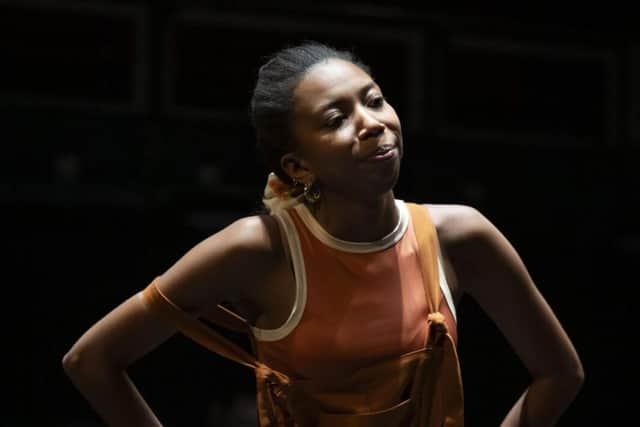
At the heart of Abigail’s rewrites is the persona of “badass Stacey,” a stereotyped, hard-as-nails Black girl from a Dagenham council estate. The physical staging shines a light on the gangsta-rapping stereotype Abigail adopts.
This one-dimensional portrayal stands in stark contrast to Abigail’s true self. Through Nicole's portrayal, we catch snapshots of the real Abigail—her warmth, her love for her mother, and her deep connection to her art—qualities that the stereotype of "Badass Stacey" entirely overlooks.
Abigail’s mother, played by Debra Baker reveals her multi-faceted nature, bringing an emotional intensity to the play.

From pint glasses and West Ham FC scarves to ashtrays, familiar symbols of working-class life frame Abigail’s artistic descent. The centrepiece—a shallow grave—provides a haunting metaphor for the fusion of art and grief.
Abigail’s brother, deftly played by Samuel Armfield, adds complexity to the story, challenging her idealised memory of their mother.
His perspective, that their mother treated him differently and left him feeling second best, forces Abigail to confront the multiplicity of stories that exist even within a single family. This subplot provides a striking commentary on how different perspectives shape the truth and how deeply family dynamics influence our understanding of loss.
As the council looms over Abigail with the threat of a council funeral, a sense of urgency is created that mirrors her frantic rewrites. The wheels of commercialisation keep turning, pushing her further from her truth with each draft.
Despite the heavy themes—grief, social class, stereotypes—the play moves at a brisk pace and the dialogue crackles with quick wit and energy.
The quick shifts between Abigail’s real life and the dramatisation of her script keep the audience engaged.
The play’s strength lies in its ability to weave these weighty issues into an engaging, fast-moving theatrical piece that provides punchy comic moments and fine acting by all three cast members, Samuel Armfield, Debra Baker and Nicole Sawyer.
Ultimately, it is Abigail’s mother’s voice that resonates most: “Don’t confuse their version of your life for your own,” she warns. It’s a powerful reminder to resist the pressures to reshape personal stories to fit the mould of what society deems marketable.
Abigail’s journey is one that many can relate to—the struggle to hold onto authenticity in the face of external demands and conformity.
This timely play explores the tension between art and commerce, loss and memory and social class in a way that feels relevant.
A co-production between Paines Plough, Mercury Theatre, Belgrade Theatre, Landmark Theatres and Royal & Derngate, My Mother’s Funeral will run to Saturday 5th October.